If The Shoe Fits…

At least once a week when I ask someone what their shoe size is, I get the following answer, “It depends on whether I’m wearing tennis shoes or other shoes”. When asked to clarify, I am told the tennis shoes are always purchased a size larger than the other shoes. Translation. “I wear a size 8 in my workout shoes and a size 7 in all of my other shoes”. Does this make sense? Of course not.

heel.gif

The way you determine proper size should be consistent no matter what style shoe you wear. If your heel to toe measurement is an 8, then that’s your correct size. If your heel to ball measures a 7, then that’s your correct size. Your correct size should be independent of shoe design, unless of course the shoe being measured is not true to size, i.e. ‘disproportional’, in which case all bets are off.

It’s a Stretch

Just like clothes, few shoes fit perfectly “off the rack”. Most need some tailoring to fit. Do you have an issue with bunions or hammertoes and tight shoe fit? A shoe stretcher is the perfect trick. People will gladly pay to have a single pair of shoes stretched, but you can do dozens of shoes at home easily, safely, and for a lot less money and a lot more fun.

shoe_stretch_2.gif

The first thing to determine is what type of shoe stretcher you need. There are stretchers for high heels, stretchers for boots and stretchers for flats. There are shoe stretchers which can raise the toe box, raise the vamp or make the forefoot wider. And don’t forget the nobs, (think Mr. Potato Head), which when perfectly placed, can spot stretch even the tightest area. Now we come to sizes, which range from the tiniest, tightest high heel to the biggest, widest military boot.

vamp_stretch_2.gif

Your tools…shoe stretch spray (our favorite is Wiley’s) your shoe stretcher and an uncomfortably tight shoe with a leather upper. Synthetics need not apply.
Spray in the appropriate area, insert the stretcher, twist the handle clockwise and set aside for 24-48 hours. Remove the stretcher, try both shoes on again and see if the stretched shoe now fits. If not, remove, re-insert the stretcher and repeat.

Worn Sock Liners – Windows to Your Soles

How many of us check the insides of our shoes? If you’re like most of us, never, right? Well, you may want to get better acquainted with the insides of your shoes.
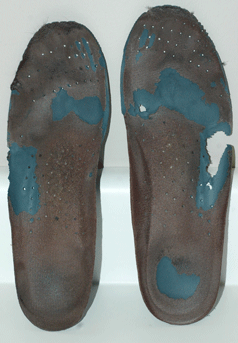
worn_sock_liners.gif
Above is a worn pair of sock liners I removed from a pair of Rockport shoes. Even without a podiatry degree, you should be able to see significant signs of wear and tear. Amazing, how different the right and left foot wear patterns are. Notice the right sock liner with the big hole on the outside? Even if you never see the foot, you would still worry that something important alignment-wise might be happening on the right foot side. And you would be right… Achilles tendonitis on the right side. See? Worn sock liners really can be the window to your sole!

Shoe Review – New Balance 858

I enjoy asking someone their shoe size right before I measure their foot…According to my unscientific research, at least 70% of the feet I measure, are being put into the wrong size shoe.

I don’t enjoy discovering that someone’s foot size (heel to ball) measures an 11.5 and the running shoes they have been wearing is a 10…which might also explain why their toenails are turning purple.
7769-484813-51.jpg
And…I am shocked and appalled when I come across a shoe that has a different heel to ball length vs. heel to toe length. New Balance 858 is such a shoe. A design flaw, I call ‘disproportionate’. In this case, the shoes arch length is long relative to the toe box length. Fine for someone who has really short stubby toes, but way too short in the toe box for the rest of us. Oh, I almost forgot, that would be short stubby toes and narrow foot, because of the narrow outsole, which makes this shoe a nearly impossible match to anyones foot.

To their credit, New Balance makes many styles of shoes, and this is one very specific style. And this one style doesn’t make all New Balance shoes bad, (i.e, “1 bad apple don’t spoil the whole bunch, girl…”) and most manufactures make ‘disproportionate’ shoes once in a while.

As a member of my posse, your job will be to stop buying disproportionate shoes. Eventually, when these styles don’t sell, shoe manufacturers will stop producing them, and eventually, shoes will start to fit better.

Heel Slippage: Slip-On Styles With Elastic Insets

Do you experience heel slippage in your slip on shoe styles (loafers, flats)? Do you have a high arched foot or two different sized feet? If so, you may want to check the vamp length.

vamp.gif

The picture above shows two different vamp/tongue lengths on slip on styles of shoes with elastic insets. The brown shoe has a shorter vamp length and the black shoe has a longer vamp length.

For this person the brown pair barely stayed on, because of her very high arch coupled with the short vamp length. The black shoe on the other hand,  made much more surface area contact with the foot (think form fitting), creating a much more secure environment.

This is also important if you have one foot shorter than the other, because the short vamp won’t contact the foot enough to stay on, hence slippage or even falling off…especially if you’re running to catch a cab and you forget to hold the shoe on by gripping with your toes!

More Sandal Adjustment

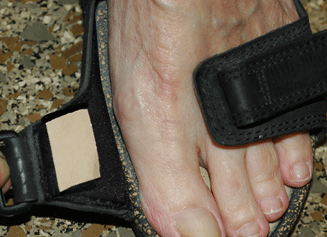
It’s seasonably warm in the Bay Area this fall and sandal wearing still abounds. Thanksgiving week someone walked into my office wearing sandals, whose strap was rubbing and irritating the top of her big toe. In spite of her visit being related to something entirely different, I couldn’t pass up the opportunity to correct her strangulating strap. If you suffer from this, here’s a surefire fix. Simply unbuckle the offending strap, and secure a 1/8″ thick square of Wiley’s Felt Remedy to the strap underside. A quick re-buckle and problem solved! This trick also works for Mary Jane staps (flats or heels) as well.

sandal_2.gif

Shoes & Polish

polish.gif

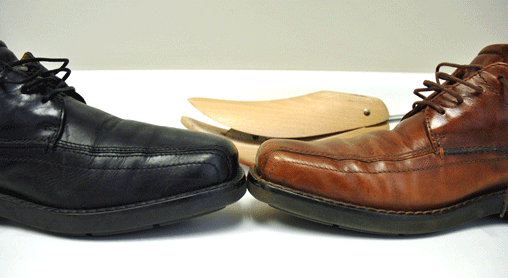
How easy is this? AK comes in today, tells me he needs to replace the above shoes because they’re worn out.

I turn the shoe upside down and the sole looks brand new. I set the shoes on a level surface and the heel counter’s are upright. Perplexed I ask “why do you need new shoes”. His reply, “these look terrible“.

Faster than the speed of light, I whip out my brown shoe polish, baby soft cotton cloth, apply a dab of polish, buff and within seconds, his shoes look brand new.

Moral of the Story: Shoes are expensive. Don’t toss a perfectly good pair of shoes out, just because the color is scuffed. My current favorite polish is WS Robson’s Finest Beeswax & Carnuba Shoe Polish. My husband likes Lincoln brand. Bottom line, the brand isn’t as important as the shine.

Shoe Lacing – Top Of The Foot Pain

shoe_lacing.gif

High arched (cavus) feet often have a big bump, mid-arch on top. Occasionally this creates numbness, tingling or pain, especially if the laces tightly crisscross over the top of the bump.

Solution: Just like the shoe above, lacce on either side of the bump and not directly over. The fit at the ankle will still be snug. Try it – only thing you’ll miss is the pain.

Excessive Wear

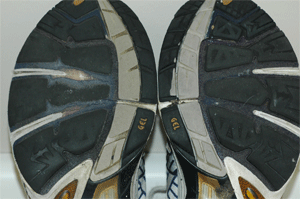
outsole_wear.gif

Neuroma (burning forefoot) pain, right foot, only when working out. Shoe review identified the following two problems.

Problem Number 1: Shoes are 1 size too short. This causes the widest part of the forefoot to be forced into the tapered part of the shoe, kinda like a vice-grip.

Problem Nunber 2: Paper thin outsole, right shoe, which corresponds to foot having pain. No difference between a worn outsole and being barefoot. No wait… thin outsole coupled with the wrong size, it’s worse than being barefoot in the gym!

Instep Height – Topline

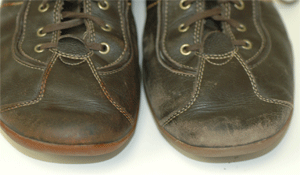
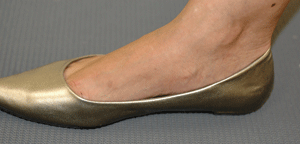
In order for a shoe to stay on your foot, the topline or instep part of the shoe needs to cover your arch. If it doesn’t, the only way you will be able to keep the shoe on will be to grip with your toes, which will create problems including blisters and hammetoes. In order to avoid this, make sure the topline is high. The following pictures show toplines which are too low.

dsc_0014a.gif

dsc_0010c.gif

Pump Bump/Haglund’s Deformity

If you’re a male, a protruding bump at the back of the heel bone is called Haglund’s Deformity. If you’re a female, it’s called a Pump Bump. They’re both the same thing and represent excess bone forming at the back of the heel, usually because of lower leg alignment. Essentially, what happens is the the heel bone fishtails across the back of the shoe, with repetitive friction causing excess bone to form.

dsc_0002b.gif

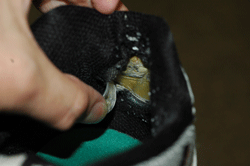
For most of us an enlarged Haglund’s or Pump Bump is harmless, but for my patient, seemingly out of nowhere, the bump started to become increasingly red and painful. Dress loafers were not the culprit, so I asked to see his workout shoes and this is what I discovered.

dsc_0007b.gif

The inside heel area of his shoe was not only excessively worn but the plastic counter had actually cracked, essentially rubbing his heel bone raw.

The solution? New shoes with careful monitoring of wear and possibly even a shoe with a soft heel counter, depending on future wear.

Toplines (shoe opening) and Twig Legs or Narrow Feet

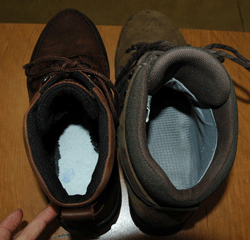
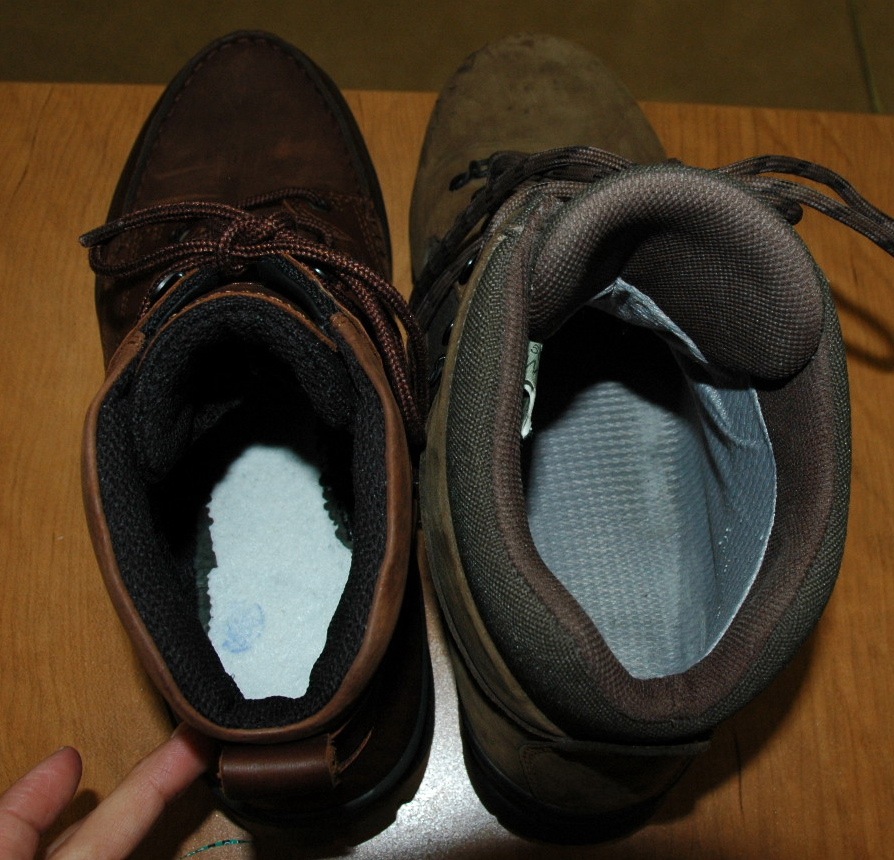
A patient has what my husband affectionately calls “twig legs”, AKA skinny ankles. His everyday shoes were hiking boots, which would otherwise be perfect if not for the big ol’ topline (shoe opening) which for his ankle, were way too wide. No matter how tight his laces were pulled, his boot still wouldn’t fit snug. His before boot is on the right, his after boot is on the left. If you have twig legs, you’ll want to check the shoe’s topline as well as the rest of the shoe fit, including depth, especially if your foot is narrow.

dsc_0007c.gif

dsc_0009a.gif


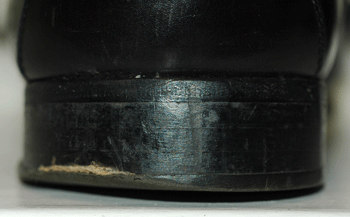
A Well Made Shoe Should Last Years

I see this at least once a week and this problem is not only unnecessary but also seems to be gender neutral. In walks a patient, with an otherwise very expensive ($400+) or even an inexpensive (<$25) pair of shoes, having an almost irreparably worn down heel.

dsc_0009b.gif


Don’t let this be your shoe. Instead, march your excessively worn heels directly to your local shoe repair shop. They’re professionals and for less than a bargain matinee and a large bag of refillable popcorn, they can create a good as new, flat level heel. Now isn’t that worth it?

In San Francisco’s Financial District, check out Jack’s Shoe Service (415.989.9434) or Anthony’s Shoe Service (415.781.1338). I have used and recommend both. Check em’ out.

Running Shoes – Forefoot Outsole Flex Grooves

A runner came in today with a moderately worn pair of Asics running shoes. Having solved her left heel pain with orthotics some time ago, she was now in my office because she started having increasingly painful ball of the foot pain during her runs.

A quick runway walk down my hall in her Asics shoes showed a stable rearfoot with no excessive pronation in site. Her orthotics were performing like a dream, so that couldn’t be it…what then? Had she changed her mileage or running surface?…No. Had she started to run at a different time of day?..No.

I thought to myself, there had to be a hidden clue – something telling about her shoes. And for me, this is where the fun comes in. I had her shoes off in a flash and got to work. Bending, flexing and twisting her shoes. Vertical heel counter – check. Proper volume – check. Mesh over her bunion – check. and then I saw it, like a lazy snake in the grass. What about the shoes outsole flex point? Could that be the problem? Yes, yes, yes!

Sure enough, when I had her put the shoes back on, I realized that the ball of her foot lay directly over the flex point. Furthermore, this area had no overlying rubber on the outsole and was simply soft EVA, which is pumped full of air for lightness but not necessarily shock absorption. Aha, that was it, the shoe was bending up at at the forefoot flex point, which hammered the ball of her foot against the ground.

This was confirmed by the fact that I had her bring her prior running shoes in which had two flex points instead of one. And neither flex point on the old shoe was centered across the ball of her foot. Another shoe success story, another injury averted and another happy patient.

Take home message – New onset foot pain is not normal. First check the feet and if they’re fine, then check the shoes. Every little thing counts, and you have to be your own best advocate and intimately get to know your shoes.

Cycling Shoes – Cleat Placement

An interesting week, two separate cyclists, two separate injuries, both caused by cleat placement. As an aside, this is a shameless plug for my friend, Jerry Durham who also happens to be an extraordinary Sports Medicine Physical Therapist and maniac Century cyclist. If you’re a cyclist with injuries, need rehab or want a custom bike fitting from someone who knows and understands the biomechanics of cycling better than anyone I’ve ever met, then Jerry is you guy.

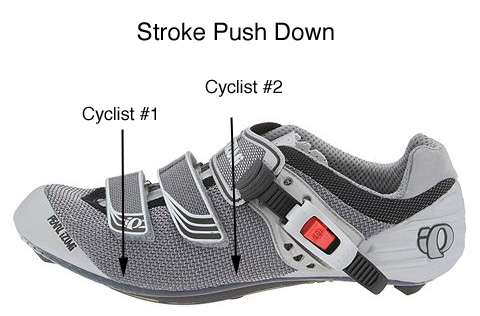
Cyclist #1: Numb toes only when cycling distances beyond 14 miles. Return of sensation usually complete by next morning. Hills, speed or terrain don’t affect onset, but distance does. Evaluation of his cycling shoes, showed that they fit perfectly.

Evaluation of his cleats, showed that they were not positioned squarely under the ball of his foot but had been moved forward by the bike shop. With a forward positioned cleat, the push down part of his stroke shifted his body weight in the shoe and because the forefoot of the cycling shoe angled up, when his body weight pushed down, it caused his forefoot to flatten due to the forward cleat placement. This in turn caused nerve compression, leading to numbness. Once we moved his cleat back the numbness stopped.

stroke_push_down.jpg

cleat_placement.jpg

Cyclist #2: This patient presented with a stress fracture right, 2nd metatarsal shaft (midfoot). Patient started riding to work 20 miles both ways, 10 miles downhill in the morning, 10 miles uphill after work at 5pm. Patient pushed himself harder and harder during the end of day ride and pleased with his efforts (and screaming endorphins), he decided to train for a Century ride. Committing to a new personal best each day, it was no wonder his foot was the only injured body part. Evaluation of his cycling shoes showed the exact opposite cleat placement from the cyclist above.

Take home message – Check your seat height and check your cleat placement. Oftentimes, cycling ball of the foot numbness can be alleviated with Superfeet, but if not – check where your pedal clips in.

Peace out.

Three Strap Sandal Adjustment

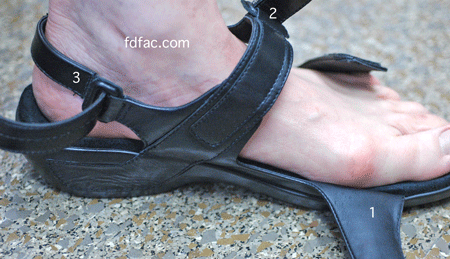
I had a patient come in yesterday with a great pair of 3-strap adjustable sandals. When I had her slip them on and walk, I was amazed at how poorly they stayed on her foot. Walking down the hall, her heel was slipping sideways and her arch appeared to drag nearly on the ground. Because none of us spend much time adjusting straps when we purchase sandals, the following is a brief instructional on a one time correct fit maneuver. Once done, you don’t have to adjust again. This simple adjustment sequence can mean the difference between comfort and sloppy.

If you have a sandal with one of the straps being behind the heel and the other one or two over the top of the foot, you always need to fit it to your foot as follows.

Open up all straps and make sure your heel to ball fits the heel to ball of the sandal correctly.

  • Start securing straps at the toe first.
  • Secure anke strap next
  • Heel strap should be secured last.
  • Leave forefoot and heel strap alone and use ankle strap to get in and out of shoe.

    sandal.gif

    Perfect Prada’s – Heel & Vamp & Adjustable Upper Straps.

    First thing Monday morning, my very stylish patient Anne arrives to pick up her new running orthotics when lo and behold, I see that she is wearing a stunning pair of Prada platform heels.

    dsc_0022a.gif

    Reasons to Love Anne’s Shoes:

    1. Platform design gives the illusion of added height without actually adding height.
    2. Platform sole and heel are wooden and very stable (think Dr. Scholl’s wooden sandals).
    3. Heel style comes straight down from counter of shoe. If given a choice, this will always be better heel design than say a kitten heel or other off center style heel.

    Nordstrom Men’s Shoes – Merrell Jungle Moc

    While shopping with my husband this afternoon I looked down at his heels and noticed, he was like one of the cobbler’s children without any shoes. He was walking on the outside of the heels of his shoes to the point that he looked like he had a limp and was hobbling from side to side. When I asked him how he could possibly walk pain free in his shoes, he replied, “I can’t, so we won’t be shopping for long”.

    Fortunately we were right next to Nordstrom and could buy new shoes, because we had a lot of shopping to do. Once in the men’s shoe salon I quickly wandered around and found him the following three pair of shoes. My husbands challenges are that his foot is very deep and he has a long heel to ball. Lace styles suit him best, but he is drawn to slip-ons because of the ease of getting them on and off.

    He wears orthotics for functional hallux limitus, i.e. sore big toe joints and is most comfortable when the shoe is torsionally stable and has an inflexible forefoot sole. Within 5 minutes, I had the following three contentenders in hand.

    1. Mephisto Gaham – Size 12
    mephistowebstore_1962_193812781.gif
    A very handsome tie shoe, wide and deep – Sticker price – $395
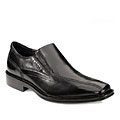
    2. Ecco Montreal – Size 46 Euro
    4951.jpg
    Beautiful slip on shoes – Sticker Price – $275
    3. Merrell Jungle Moc – Size 12
    497.jpg
    Wide and deep, very orthotic friendly – Sticker Price – $79.95

    Much to our dismay, when the shoes were retrieved, my husband was unable to fit his orthotics into the shoes. Although all shoes had removable foot beds, the heel cup of his orthotic was unable to seat fully back. The result, a tight fit in the vamp and excessive heel slippage in the back. It didn’t matter whether the shoes heel counter was soft or firm, the orthotic would still not seat back.

    Worried that we still wouldn’t be able to shop, because it was increasingly apparent my husband wouldn’t be getting shoes, I thought AHA, I know, lets remove the custom orthotics and insert a pair of mens 3/4″ Superfeet instead.

    501.jpg
    Great for flats and slip on tennis shoes – Sticker – $19.95

    Within a minute of trying these beauties on with the Merrell’s – order was restored in the world. With a kiss and hug, my prince charming had found his slipper that fit. From then on he commented more than once on how he felt as though he was walking on a cloud.

    Thanks Nordstrom. Thanks Superfeet.

    F-Scan Findings: Atypical Heel and Arch Pain

    Three very similiar patients; one female and two male, having narrow, bony feet have all had chronic, longstanding arch and/or heel pain, accompanied by extreme plantar foot “sensitivity” and pain for many years.

    Each were on the brink of disaster alignment-wise, when a seemingly benign event (new orthotic, unexpected prolonged hiking) occured, changing them forever, sending them along a downward spiral of worsening, unrelenting foot pain. All have see countless foot specialists (podiatrist,orthopedists) and have tried a bundle of different shoes and orthotics with no success whatsoever. All have also presented with shoes that are too long and deep for their bony, skinny feet.

    As a board certified orthopedic podiatrist, I would have previously tried to cushion their orthotics or grind in a plantar fascial groove to offweight an otherwise tight, bow strung, plantar fascia. What I have learned instead, using F-Scan pressure mapping is that standard orthotic treatments don’t always work. Instead, fine tuning the trajectory parameter is essential to prevent excessive dorsiflexion of digits 2 or 3 during the toe-off phase of the gait cycle.

    Before and after results are listed below. Symptomatic relief using these principles in my three patients has not been immediate, but over 2-3 months time, all patients were 80% improved from before the study trial.

    Hello world!

    Welcome to my blog. With 17 years of looking at feet and the shoes that brought them in, I realized that I know a thing or two about shoes and feet. In an effort to teach others what I know, I have created shoe class 101. During the class, I create personalized shoe fit guides for everyone who attends, but until now, I haven’t figured out a way to archive and organize all of this extremely useful information. So, I have created Jenny’s shoe blog for all of you, in hopes that by explaining and showing you what I have learned, the information will make you a little smarter too. Finding a stylish, well-fitting shoe isn’t rocket science, you just need an experienced guide. Which is where I come in. Shoe Class 101 blog, you’re officially alive.