Category Archives: Shoe Fit

Arch Blisters – Flat Feet with Orthotics

If you have flat feet, wear orthotics and plan to do a lot of hiking (Grand Canyon), or downhill walking (Stairmaster), it’s important that your shoe be as supportive as possible in the instep.

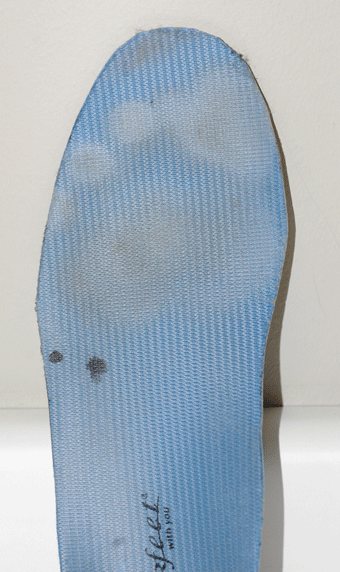
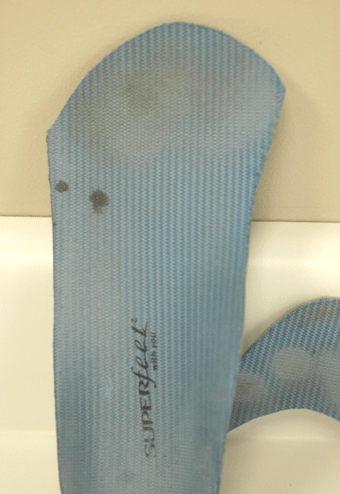
This pair of hiking boots and running shoes were brought in for me to evaluate today, because they created blisters in the arch and JA didn’t know why.

mesh_instep_blister_layered.gif

A quick walk up and down the hall, and I had to turn my eyes away because of his extreme foot collapse. There was no support to hold up the arch at all.

Flimsy cloth or mesh on the inside of a shoe will always allow the foot to pronate (collapse). Mix in orthotics, a steep downhill or two and the skin friction produced against the orthotic because of excessive pronation, can hobble even the toughest of feet.
Narrow Feet Need A Narrow Outsole

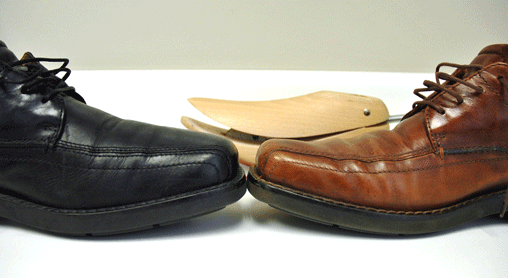
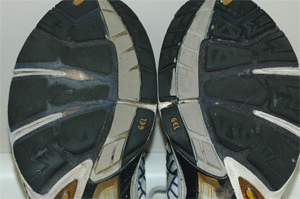
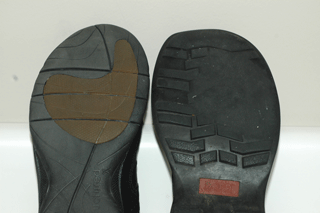
If you have a narrow foot then you need to pay attention to the outsole width. A narrow foot typically needs a narrower outsole then a wide foot. Here are two medium shoe outsoles which illustrate the difference.

outsole_width.gif

This person has a narrow foot and the shoe on the right was too wide (even though it’s a medium width) creating side to side motion in the shoe, resulting in plantar fasciitis and achilles tendonitis. Both of these conditions were non-existent in the narrower (also medium) shoe, pictured above on the left side.

Having a shoe that it too wide can be just as bad as a shoe that’s too narrow. Best to match the width of your foot to the width of the shoe.

Hammertoes & Full Length Insoles

Hammertoes are a condition where the toes draw up and the knuckles become prominent.

hammertoes.gif

For many people with hammertoes, even a thin insole or orthotic can raise the toes up to the point where the toes rub and become raw against the inside toe box of the shoe.

superfeet_full_hammertoes.gif

This pair of Superfeet full length insoles are only 1/8″ thick under the toes, but even this slight elevation is enough to cause pressure in an already crowded toe box.

The solution? Trim the insoles to just beyond the ball of the foot, or just below the toes. Shortening the insole topcover length will provide the arch support without cramping the toes.

superfeet_sulcus_hammertoes.gif

Zappos.com

Zappos.com is really a great place to find shoes. I like them because they offer free shipping, no matter how many pair of shoes you buy. I like them because the shoes arrive fast. I like them because refunds are processed right away if the shoes don’t work out, and they have a 365 day return policy.
Mostly though, I like Zappos because they offer multiview.gif the grooviest feature ever, especially if you have a hard to fit foot. Here’s an example of how I use Multiview.

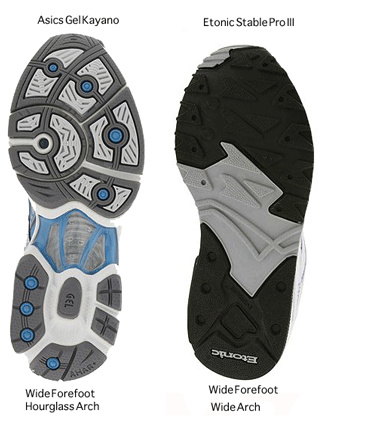
This patient has a wide, somewhat deep foot, with mild bunions. Her current shoes are Asics Gel Kayano. Although they are wide enough in the forefoot they were too narrow in the arch. Confident, I could find a better fitting shoe on Zappos.com, I started to compare other running shoes to the Asics using Multiview.

First I wanted a shoe with a wider outsole in the arch. As expected, I found several shoes which were wider than the Asics. The Etonic’s on the right, are just one example, the difference in width being immediately evident.

outsole_asics_etonic.gif

Next I wanted to compare depth. Again, the Etonic’s are much deeper than the Asics, which for this patient will provide a much better fit.
side_asics_etonic.gif

Comparing shoes using the Multiview feature can make the difference between perfect vs. not-so-perfect fit.

Running Shoe Lists – Aarghhh!

Someone came in today with a list of recommended running shoes. I hate running shoe lists. As well intended as they may be the ones I have seen are usually obsolete and tell only half the story.

Running shoe companies categorize their shoes as “Motion Control”, “Stability”, “Neutral” or “Cushioned”. Although these descriptions are useful when evaluating the lower (bottom half of shoe), they don’t take into account the upper (everything attached to the heel and sole).

Without matching both the lower and upper parts of the shoe to the upper and lower parts of your foot, you’ll wind up with a shoe that may work and then again may not.

If your a competitive runner or just enjoy a casual stroll – your foot deserves better.

Heel Slippage: Blisters & Bloody Heels

heel_slippage_blister.gif

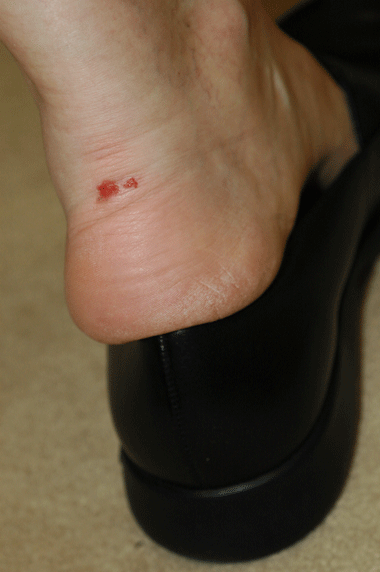
How many of us excitedly wear our brand spankin’ new shoes for a special day or night out and we wind up with bloodied, painful heels because of the shoes?

If this is you, then chances are the shoe isn’t form fitting snugly enough which results in your foot moving up and down. Couple this friction with sweat and a stiff heel counter and you’ve created a recipe for pain.

Fortunately, here’s what you can do.

  1. Make sure your shoe fit snugs. Noticeable heel slippage in the shoe department will inevitably lead to blisters if the heel counter leather is stiff.
  2. If you’re prone to heel slippage (narrow or shallow feet), avoid any slip on styles that don’t adjust in the vamp, ie. straps, buckles and Velcro.
  3. If your heels still slip, use a tongue pad or custom cut out a tongue pad from Wiley’s Felt Remedy.

Now what if I’m too late and the blisters have already formed?

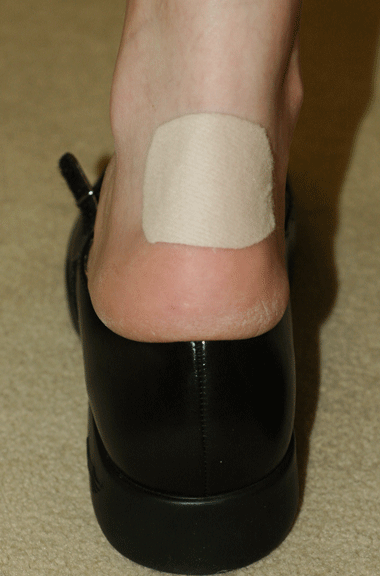
  1. Cut a generous square, with rounded corners of moleskin and completely cover the blister(s) so that it is visible above the counter of the shoe.
  2. Let the moleskin wear off on it’s own. Don’t pry off or the adhesive will take the top of the blister with it.
  3. Band-Aids aren’t big enough to help. You need t o custom cut the moleskin to ensure coverage.

heel_blister_moleskin_1.gif

heel_blister_moleskin_2.gif

Men’s Dress Shoe Review – Narrow, Shallow Foot

Zappos. com is one of my favorite places for hard to fit feet. I especially like the multi-view feature to help evaluate a shoe’s width, depth and design.

Last week I picked out a dozen pair of men’s dress shoes for Jonathan, and today he showed up with a box of 7 pair to evaluate. All, were very handsome, but only the following two pair made the cut. An added bonus, they even worked with his bulky orthotics!

Even though Jonathan has a narrow foot, he could wear these shoes which came in a medium width, because of their shallow depth.

Johnston & Murphy – Bickel Panel Toe

bickel_panel_toe.gif

Johnston & Murphy – Gosney Moc Toe Lace-Up

gosney_lace.gif

Narrow Foot, Wide Shoe – Telltale Lacing Signs

If you find that there’s little to no room between opposite eyelets when lacing your shoes, then your shoe’s probably too wide for your foot. Ditto if you can pinch folds of cloth between your first and second fingers in the toebox.

narrow_eyelets.gif

Conversely if your shoes upper when looking down, appears to be all shoelaces then your either have a really high arch, or your shoe is too narrow for your foot.

wide_tennis.gif

Shoe lacing patterns can tell you a lot about whether or not your shoe’s upper is the correct fit.

High Heels & Hills

heels_gap_back.gif

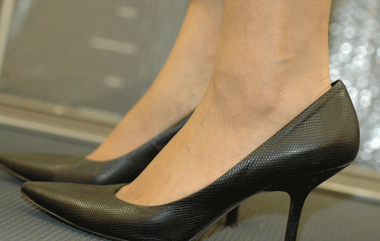
If your foot slides forward (heel gapping above), while wearing high heels when walking on even a slight incline, 9 times out of 10, the balls of your feet will hurt. Trying to cushion or pad this forefoot area inside the shoe will only make it worse.

When wearing high heels, the shoe has to fit snug or you’ll slide. The best way to accomplish this is making sure your heel to ball matches the shoe’s heel to ball and if you slide, use Wiley’s felt remedy in the vamp and not a metatarsal pad.

If you slide, not only will the widest part of your foot move forward into the tapering toe, but you will also lose contact with the arch and your base of support. Ouch!

Best Time to Shop for Shoes

The best time to shop for new shoes is at the end of the day when your feet are their most swollen and sensitive to shoe fit. Here’s a picture of a shoe which is a) too tight and b) too tight. Notice the blanching around the throatline. Notice how the widest part of the forefoot is lopping over the outsole.

Rule of thumb…if a shoe feels or looks tight in the store (especially in the morning), it’s probably not going to fit later, unless you have a shoe stretcher. Bottom line, a fabulous shoe on sale, that’s too tight is no bargain…trust me, they’ll simply collect dust in the back of your closet.

blanch_1.gif

Size Matters (Heel to Ball vs. Heel to Toe)

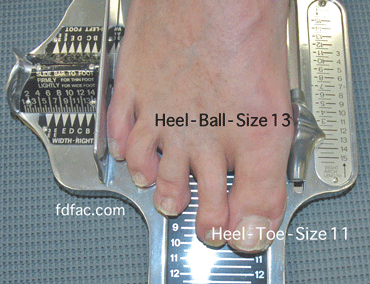
Almost everyone who comes into my office, gets their foot measured. Why? Because wearing the wrong size shoe can cause pain and most people have no idea what their foot size really is. When was the last time you had your foot measured? Do you know the difference between to heel to toe and heel to ball? You should…it’s important, and it can mean the difference between comfort and pain.

The following pictures illustrate these two different foot measurements. The first person’s foot measures a 13 (heel to ball) and the 2nd person’s foot measures a 7.5 (heel to toe). Some of us have a longer heel to ball measurement and some of us have a longer heel to toe measurement. Whichever measurement is longer (heel to toe or heel to ball), that’s what size you are.

heel_ball.gifheel_toe.gif

Bunion Pain

For those of you with bunions, it’s important that your shoe not constrict around the bump. Things to avoid over the bump include – Decorative trim, stitching or anything unforgiving. Today’s shoe is an example of what not to wear.

bunion.gif

If The Shoe Fits…

At least once a week when I ask someone what their shoe size is, I get the following answer, “It depends on whether I’m wearing tennis shoes or other shoes”. When asked to clarify, I am told the tennis shoes are always purchased a size larger than the other shoes. Translation. “I wear a size 8 in my workout shoes and a size 7 in all of my other shoes”. Does this make sense? Of course not.

heel.gif

The way you determine proper size should be consistent no matter what style shoe you wear. If your heel to toe measurement is an 8, then that’s your correct size. If your heel to ball measures a 7, then that’s your correct size. Your correct size should be independent of shoe design, unless of course the shoe being measured is not true to size, i.e. ‘disproportional’, in which case all bets are off.

It’s a Stretch

Just like clothes, few shoes fit perfectly “off the rack”. Most need some tailoring to fit. Do you have an issue with bunions or hammertoes and tight shoe fit? A shoe stretcher is the perfect trick. People will gladly pay to have a single pair of shoes stretched, but you can do dozens of shoes at home easily, safely, and for a lot less money and a lot more fun.

shoe_stretch_2.gif

The first thing to determine is what type of shoe stretcher you need. There are stretchers for high heels, stretchers for boots and stretchers for flats. There are shoe stretchers which can raise the toe box, raise the vamp or make the forefoot wider. And don’t forget the nobs, (think Mr. Potato Head), which when perfectly placed, can spot stretch even the tightest area. Now we come to sizes, which range from the tiniest, tightest high heel to the biggest, widest military boot.

vamp_stretch_2.gif

Your tools…shoe stretch spray (our favorite is Wiley’s) your shoe stretcher and an uncomfortably tight shoe with a leather upper. Synthetics need not apply.
Spray in the appropriate area, insert the stretcher, twist the handle clockwise and set aside for 24-48 hours. Remove the stretcher, try both shoes on again and see if the stretched shoe now fits. If not, remove, re-insert the stretcher and repeat.

Heel Slippage: Slip-On Styles With Elastic Insets

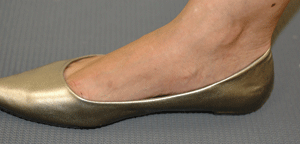
Do you experience heel slippage in your slip on shoe styles (loafers, flats)? Do you have a high arched foot or two different sized feet? If so, you may want to check the vamp length.

vamp.gif

The picture above shows two different vamp/tongue lengths on slip on styles of shoes with elastic insets. The brown shoe has a shorter vamp length and the black shoe has a longer vamp length.

For this person the brown pair barely stayed on, because of her very high arch coupled with the short vamp length. The black shoe on the other hand,  made much more surface area contact with the foot (think form fitting), creating a much more secure environment.

This is also important if you have one foot shorter than the other, because the short vamp won’t contact the foot enough to stay on, hence slippage or even falling off…especially if you’re running to catch a cab and you forget to hold the shoe on by gripping with your toes!

More Sandal Adjustment

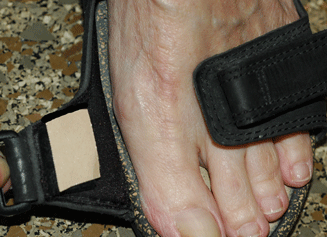
It’s seasonably warm in the Bay Area this fall and sandal wearing still abounds. Thanksgiving week someone walked into my office wearing sandals, whose strap was rubbing and irritating the top of her big toe. In spite of her visit being related to something entirely different, I couldn’t pass up the opportunity to correct her strangulating strap. If you suffer from this, here’s a surefire fix. Simply unbuckle the offending strap, and secure a 1/8″ thick square of Wiley’s Felt Remedy to the strap underside. A quick re-buckle and problem solved! This trick also works for Mary Jane staps (flats or heels) as well.

sandal_2.gif

Shoe Lacing – Top Of The Foot Pain

shoe_lacing.gif

High arched (cavus) feet often have a big bump, mid-arch on top. Occasionally this creates numbness, tingling or pain, especially if the laces tightly crisscross over the top of the bump.

Solution: Just like the shoe above, lacce on either side of the bump and not directly over. The fit at the ankle will still be snug. Try it – only thing you’ll miss is the pain.

Excessive Wear

outsole_wear.gif

Neuroma (burning forefoot) pain, right foot, only when working out. Shoe review identified the following two problems.

Problem Number 1: Shoes are 1 size too short. This causes the widest part of the forefoot to be forced into the tapered part of the shoe, kinda like a vice-grip.

Problem Nunber 2: Paper thin outsole, right shoe, which corresponds to foot having pain. No difference between a worn outsole and being barefoot. No wait… thin outsole coupled with the wrong size, it’s worse than being barefoot in the gym!

Instep Height – Topline

In order for a shoe to stay on your foot, the topline or instep part of the shoe needs to cover your arch. If it doesn’t, the only way you will be able to keep the shoe on will be to grip with your toes, which will create problems including blisters and hammetoes. In order to avoid this, make sure the topline is high. The following pictures show toplines which are too low.

dsc_0014a.gif

dsc_0010c.gif

Three Strap Sandal Adjustment

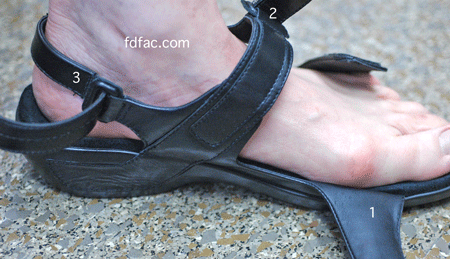
I had a patient come in yesterday with a great pair of 3-strap adjustable sandals. When I had her slip them on and walk, I was amazed at how poorly they stayed on her foot. Walking down the hall, her heel was slipping sideways and her arch appeared to drag nearly on the ground. Because none of us spend much time adjusting straps when we purchase sandals, the following is a brief instructional on a one time correct fit maneuver. Once done, you don’t have to adjust again. This simple adjustment sequence can mean the difference between comfort and sloppy.

If you have a sandal with one of the straps being behind the heel and the other one or two over the top of the foot, you always need to fit it to your foot as follows.

Open up all straps and make sure your heel to ball fits the heel to ball of the sandal correctly.

  • Start securing straps at the toe first.
  • Secure anke strap next
  • Heel strap should be secured last.
  • Leave forefoot and heel strap alone and use ankle strap to get in and out of shoe.

    sandal.gif