Category Archives: Shoe Fit

Shoe Review – New Balance 768

Reader Andrea asks “Could you please review the New Balance 767? I have a relatively narrow foot and wear orthotics for my high and collapsing arch.”

I’m not familiar with the NB 767 model, but I am familiar with the 768 which is the next version. My problem with the 768 is it has a very deep toe box even in the narrow width.

On the plus side – it will work with an orthotic and it won’t strangulate your high arch. Just make sure it doesn’t fail the pinch test: https://drshoe.wordpress.com/2008/01/15/pinch-test-shoe-toebox/

If it does, then you might want to try Asics 2130 in medium, since this has a shallower toe box, fits the narrow foot with a high arch nicely and will work with an orthotic.


Sandals With Adjustable Straps

With summer almost here, many of us will be switching to sandals. For those of us who have developed the bad habit of slipping our sandals on and off without tightening…Stop It.

Not to sound like your mother, but shoes which adjust (tie, buckle, Velcro) need to be snugly secured each and every time you put them on. If you don’t do this, then you’ll experience excessive heel slippage and toe gripping, which can cause hammertoes and blisters to name just a few.

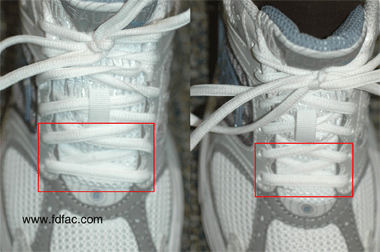
Here is a wedge sandal which was typically slipped on and off. The image on the left shoes proper fit and the image on the right shows sloppy fit. Which version would you rather wear?

Men’s vs. Women’s Shoe Sizes (Brannock Device)

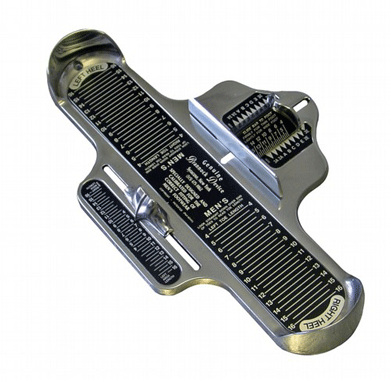
In the 1920’s, Charles Brannock invented a measuring device, which bears his name and is still used today in most retail shoe stores.

According to the Brannock Device, men’s shoe sizes are one size larger than women’s. For example a men’s size 9 shoe would fit a woman’s size 10 foot. The size increments for both are 1/3″ difference between each size. So if you need to go up or down a half size, you’re only changing the size by 1/6″. Not nearly as much as most of us think.

There is also a nifty conversion chart on the Brannock Device’s website which differentiates different sizing systems, including children and European sizes as well.

Here’s the link http://brannock.com/cgi-bin/start.cgi/brannock/charts.html

High Heels Having Same Heel Height – Boots vs. Non-Boots

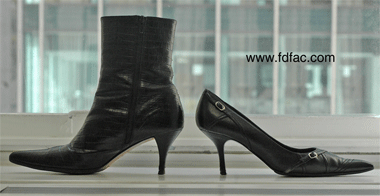
Given a choice between two pair of high heels with the same heel height, one boot and one non-boot, the boot will always win (given the same width).

A boot keeps the foot better aligned with the ankle, which increases stability, reduces wobble and allows for more comfortable walking.

If you’ve got a night out on the town of club hopping and dancing – then a boot will always be a better choice.

Shoe Review – La Sportiva Trango Trek GTX

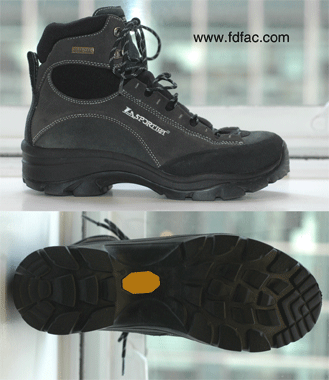
Thanks to Bill for bringing in this pair of hiking boot today. This is a great boot if you have a narrow, deep foot. Vasque is for a narrow shallow foot, whereas LaSportiva is for those feet having slightly more volume with a narrow width.

This is a sturdy hiking boot good for variable terrain including lots of hills. It also cinches up tight for narrower ankles.This boot can be found at REI and several other retailers for around $180.

Heel Slippage – Improper Shoe Lacing

When heel slippage happens, most people intuitively tighten their shoe laces at the ankle, which won’t help with slippage. The laces which need to be laced the tightest are the furthest away from the ankle.

It’s a bit of a pain, but each and every time you lace your shoes, you’ll want to start at the toes and progressively cinch up until you reach the ankle.

When lacing shoes with heel slippage, 9 times out of 10, lacing correctly will ensure a snug fit. You will also want to relace your shoes, when wearing an orthotic for the first time.

Shoe Sizes Beyond 12 (men) or 11 (womens)

If you wear a men’s shoe greater than size 12 or a women’s shoe greater than size 11, you will have difficulty shoe shopping. Why? Because a bigger size means more inconsistency in width, length and depth.

Bigger sizes also usually don’t have half sizes, which makes finding the right fit even more dififcult.

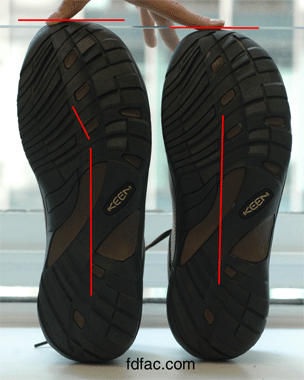
Here are two pair of the same Keen shoes. A size 13 on the left and a size 12 on the right.

Notice how the size 13 is longer and more curved? This is clearly not one size larger, since a full size should only be 1/3″.

Bottom line, if your size falls into this category, you’ve got to pay particular attention to sizing and fit.

Shoe Review – Asics 2120

This is one of my favorite shoes for shallow (narrow or wide) feet. Added bonus, it’s also very stable, with a firm heel counter (back of heel) and great torsional stability (doesn’t twist).

This shoe is narrower than the 2130 or the Gel Kayano. It’s also works if you have a wide foot or a foot with a bunion.

I recommend this shoe at least once a day. Only problem is, the women’s narrow (2A) size is almost impossible to find and doesn’t work too well with an orthotic because it’s too narrow for an average sport orthotic to fit in. The men’s narrow (B) easily accomodates an orthotic and has fit every narrow, shallow foot I’ve fit, perfectly.

Running Shoes – Making an Orthotic Fit

Blog reader Cherilyn asks I am trying to find a running shoe that accommodates my orthotics; a shoe with a deep foot-bed. Do you have any recommendations?”

Since prescription custom orthotics should match your foot, then if your foot matches your shoe, so too should your orthotic. Also, a custom orthotic made by a sports medicine podiatrist, is never as wide as your foot anyway, so there shouldn’t be any problem fitting it into a running shoe.

If you can’t get your orthotic into your running shoe, then either your shoe fit is wrong (length, width, depth), or your orthotic is wrong. Once made, an orthotic should work in all similar styles of shoes. For example an orthotic which fits into a pair of Asics 2130 should also fit into a pair of Brooks Adrenaline. A sport orthotic on the other hand will usually not fit into a non-athletic shoe, (flats, loafers), because of lack of room.

Most of the running shoes I’ve featured on my blog work great with orthotics. Saucony, Brooks, Asics, New Balance, Adidas and Nike all have lots of styles, which when fit properly will absolutely accommodate an orthotic.

Nordstrom San Francisco – Steve Brown, Men’s Shoes

When in San Francisco looking for men’s shoes, look no further than Nordstom San Francisco Center and Steve Brown. Steve is one of those rare career shoe salesman, who is more interested in making sure your shoes fit right than in commission.

Working in men’s shoes for nearly three decades, Steve knows feet and he knows men’s shoes. I trust my family with him. I trust my patient’s with him. What more can I say than that? Call ahead for his hours and days working.

Nordstrom San Francisco Centre
865 Market Street
San Francisco, CA 94103
(415) 243-8500

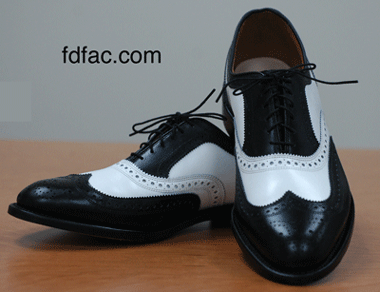
Shoe of the Month – Allen Edmonds Broadstreet Saddle Shoe

At least once a month, someone brings in a shoe that is so fine, it needs its own shoe review.

This months shoe was brought in by Randolph and is so gorgeous, that everyone in the office had to stop and admire. It’s perfect for a narrow foot and comes in brown too.

A spectator style from the 30’s, this shoe is also part of Allen Edmonds, Custom Program. Which means you may order any current style in any color or leather in their line. You may decide to substitute one type of sole for another. They will also customize footwear for individuals with feet of two different sizes.

Allen Edmonds – what a great Company!

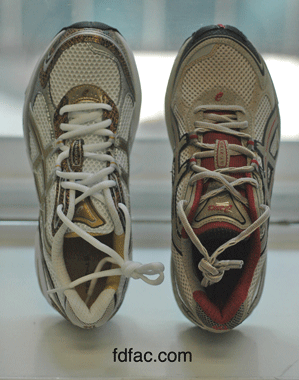
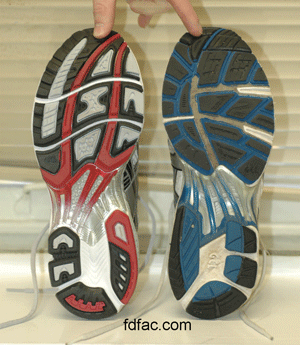
Shoe Review – Asics 2130 (Running vs. Trail Shoes)

I ordered a pair of Asics 2130 running shoes from Zappos.com which turned out to be slightly short. Since I do more outdoor walking than running, I decided to order the Asics 2130 trail shoes instead, and was surprised to discover they are not the same shoe. The running 2130 is on the left, whereas the trail running 2130 is on the right.

The 2130 trail shoes are much wider than the Asics 2130 running shoes. The Asics 2130 trail shoes are much deeper than the running shoe version.

And the Asics 2130 running shoe is shorter than the same length 2130 trail running shoe.

Once again even though both shoes have the same name and outsole design, they are entirely different shoes. Make sure you thoroughly check the different version of the same shoe, because more and more, they will not be the same.

Shoe Review – Brooks Dyad for Wide Feet

I had a runner come it today with 3 different pair of running shoes.

The first pair were Brooks Adrenaline – which were much too narrow for her wide, deep foot. The next pair she tried were Saucony Pro Grid Omni which were better than the Adrenaline, but still too narrow in the waist (center arch) of the shoe. The shoes which fit the best are the Brooks Dyad, which as you can see, barely hourglass in.

Now look at the upper. Although both shoes are made by Brooks – they are different widths. The Dyad is wide, whereas the Adrenaline has a narrower upper.

When buying shoes, always check the outsole of your shoe, because just like Goldilocks, eventually, you’ll find an outsole which will be “just right”.

Below the Knee Boots – Customizing fit

If your legs swim in the shaft (top part) part of boots, you can always have them taken in. An old school shoe repair person can do this for you. The process is similar to tailoring clothes.

custom_boots.gif

The above pair of boots were modified to narrow the shaft by Gino at Anthony’s Shoe Service, Union Square, San Francisco. Well worth the $80 cost of getting a perfect boot, calf fit.

If you have trouble finding boots that fit snug, a talented shoe repair person, can be your new best friend. Ask around, chances are there is just such a person in your City or Town.


New Balance 645 vs. Brooks Infiniti

I’m always on the lookout for men’s narrow running shoes. Searching through Zappos.com I found the New Balance 645 running shoes and the Brooks Infiniti running shoes for a patient of mine. Both have narrow outsoles with the New Balance being slightly narrower overall than the the Brooks.

nbmr645_brooksinfinity.gif

Next comes the upper. The New Balance toebox is deep, whereas the Brooks toebox is shallow which was exactly what I was looking for.

nb_brooks.gif

I also like the Brooks Infiniti because it has a firm medial (grey) outsole. The Brooks Adrenaline (not shown) is similar in upper design, but will be much less long lasting because of its softer the outsole.

The only downside with the Infiniti? The price tag. $124 on Zappos. com. I usually prefer a more affordable running shoes (Asics 2130), but if this is your foot, then it’s probably worth it to you. Especially given how difficult shopping for a well fitting running shoe can be.

Nike Air Zoom Katana Cage II vs. Nike Air Refresh+

I was helping a runner find a new running shoe for her narrow shallow feet. Her old running shoes were Nike Air Zoom and fit her to a “T”.

The problem? Her perfectly fitting running shoes were discontinued and she was forced to buy the men’s version, which were similar, but much too wide for her narrow foot.

Armed with Zappos.com multi-view feature, I found two pair of potential replacement running shoes, both in a size 10.

nike.gif

Once again, even though both shoes were made by Nike and both shoes were sized 10, they were not the same length. The Katana Cage was easily 2 sizes shorter in the toe box and one size shorter in heel to ball measurement than the Air Refresh+. The Air Refresh+ on the other hand was proportional and fit perfectly, just like the original Air Zoom’s.

If you’ve got a very narrow, shallow foot, the Air Refresh+ is a great shoe for you. It’s also got the + technology, so grab your iPod Nano and go for a refreshing run!

Wider Puma Alternative

Reader Dave asks “Would you happen to know of any type of shoe for a street dancer? Right now I wear Pumas because they’re light and there are great styles but these Pumas are a bit tight on me.”

Dave’s right, Puma’s are lightweight but they are very narrow and shallow.

These images show two similarly designed shoes. Saucony are the deepest and widest, but the Asics are still better than the very shallow, narrow Puma, both in depth and outsole width. Just like the Puma, Saucony and Asics are also affordable.

street_performer.gif

Fortunately, most designers make similar styles, so if you’ve got your heart set on a certain style don’t despair, just try another manufacturer.

Ian’s Shoelace Site

Ruby slippers to reader Paul for reminding me about one of my favorite websites Ian’s Shoelace Site: http://www.fieggen.com/shoelace/index.htm

This site has every lacing pattern imaginable with terrific step by step directions on how to lace each style. Want fun? Want fancy? Then Ian’s shoelace site is the place for you.

If you’ve got a special way of lacing, send me a description and image and I’ll post on my blog. If it works for you, it will probably be useful for others, so why not share?

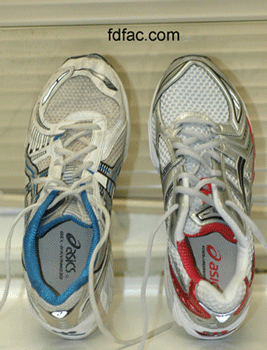
Shoe Review – Asics GEL-Kayano

A marathon runner came in today with a worn pair of GEL-Kayano 12 and a new pair of GEL-Kayano 14. Even though both shoes were sized the same length and width, they were entirely different shoes.

gel_kayano.gif

First, look at the outsole. The newer version is on the left and the older version is on the right. There is more soft EVA in the worn outsole on the right, which would cause the forefoot padding of the shoe to break down sooner.

If you have a history of ball of the foot pain (capsulitis, sesamoiditis, metatarsalgia), you will want your outsole EVA to be as firm as possible, so the left model would be better for you.

gel_kayano_3.gif

Next look at the upper. See how the older Asics on the left is wider in the toebox and in the heel opening or throatline? In this case, if you have a wider foot or a higher arch, the older version would be a better fit for you.

All in all, even though the name is the same, the versions are not. Bottom line – these differing versions are entirely different shoes. Although both are shallow in toebox depth, version 12 will work best if you have a wide, shallow foot whereas version 14 will work better if you have a narrow, shallow foot.

Beware of version upgrades and check them carefully. Even if you shoe salesman swears up and down there is no difference, don’t take their word for it, make sure with your own eyes and hands it is indeed the same shoe.

Modified Roman Lacing

Ruby slippers to reader Paul for showing us this modified Roman lacing style. This lacing combines the strait and criss-cross lacing patterns. The first lace is straight whereas the following laces are all criss-cross. As you can see, Paul cinches up each set of laces to secure a snug fit. Unlike the full straight lacing pattern, this one gives you a spiffier look, while still maintaining fit.

roman_lacing_2.gif