Category Archives: Shoe Fit

Corns – Top of Toes

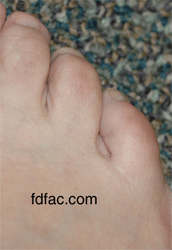
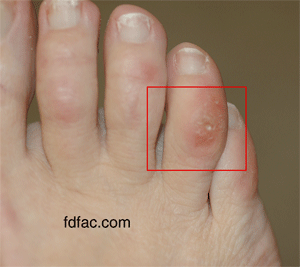
Here’s an image of a corn on the top of the 4th toe. You can imagine how painful this hard, dead skin can be.

corn__4th.gif

If you get corns on the tops of your toes, you’ll want to check the depth of your shoes toebox. If you toebox is not tall enough, you need to find deeper shoes, or you can stretch your toebox to increase the depth.

Pinch Test – Slip On Shoes

Here is another image of a shoe that is too deep. Notice how much excess upper there is?

pinch_test_4.gif

If your upper does not form fit to your foot then the shoe won’t stay on. It doesn’t matter if you use a tongue pad or wear really thick socks, the result will be the same. A sloppy, poor fit. You’re feet deserve better.

Orthotics Too Wide For Heels of Shoes

Here’s an example of an orthotic that doesn’t fit properly in the shoe. An orthotic shouldn’t push the sides of your shoes and heels apart as seen in this right shoe.

orthotics_wide_heels.gif

What an orthotic should do, is easily fit into the back and arch of your shoe. Notice how the heel of the shoe with the orthotic in it is round in shape, whereas the shoe without the orthotic, is much tighter in the back of the heel?

Custom orthotics should not cause your heels to slip or push out the sides of your shoes. Since different types of orthotics can be made for all of your different types of shoes (heels vs. flats vs. running shoes), you should ask your podiatrist about getting multiple pairs of orthotics if you wear lots of different shoes.

Shoe Review – Privo Ronan

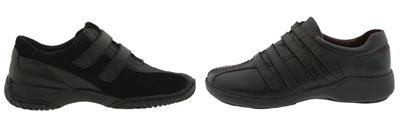
In general, I like many of Clark’s Privo Styles. I especially like this Ronan style because:

  • Shallow toe box – If you’re heels slip up and down in casual or flats type shoes, then you foot probably flattens out when you walk. In this case, the volume of your foot is less than the interior volume of your shoe. The Ronan toe box scoops down and is shallow over the toes, matching more closely the volume of your forefoot.

privo_ronan_1.gif

  • Removable insole – The insole of this shoe is thick and removable. That means if your need to wear custom orthotics, you’ll have enough room for your orthotics, once you take out the shoes insoles.
  • Adjustable vamp – This is also helpful if your heels typically slip. The elastic is adjustable and in exactly the right spot for the upper to form fit.

privo_ronan_2.gif

This shoe will work if you have a wide, shallow (low volume) foot, with ball of the foot pain, hallux limitus pain or neuroma pain.

This shoe won’t work if you have a bunion. Unfortunately, there is stitching right over the bump, making the shoe much too tight where you need it the most.

Stay tuned though – I will be blogging about another Privo style that is perfect for a bunion foot.

Nike Air Pegasus vs. New Balance 992

This person’s foot size measured a 7 1/2 narrow. Imagine my surprise when I placed her current shoes side by side, end up and discovered the following:

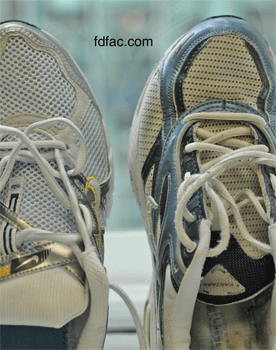
nike_new_balance.gif

The Nike Air Pegasus on the left was sized 7 1/2, while the New Balance 992 on the right was sized a 7.0. Even though the New Balance was lasted smaller, it was easily a size longer and considerably deeper than the other shoe.

When shopping for shoes it is important to keep in mind, that size is an approximation only, and not necessarily consistent from shoe to shoe. In the case the size 7 1/2 Nike shoes fit like a glove, whereas the size 7.o New Balance were much too long and deep.

As with everything. Buyer beware – you can’t judge a shoe by a manufactures designated size.

Shoe Review – Men’s Clarks Un.seal

I’m usually not a fan of slip on shoes for anyone (male or female) having a wide foot and a high arch.

cavus_foot.gif

Clark’s Un.Seal is an exception. The vamp is long and the elastic insets are minimal. The toe-box is wide but not so deep that you can pinch excess leather in the toe-box area. This person is also wearing men’s 3/4 Superfeet insoles for added support and comfort.

clarks_unseal.gif

This shoe would not work for someone having a narrow foot with a high arch, or a narrow foot with a flat arch. Those foot types would swim in this shoe.

However, if your foot looks like the foot above, then this a perfect leather, casual shoe for you. You can dress up jeans or Khaki’s with this shoe and you’ll always look great.

Painful 5th Toes, Running Shoe Must Haves

Many people have curled 5th (pinky) toes. This rotation, usually causes the outside of the toe to become prominent. When this happens, your shoe rubs against the protrusion, creating friction against the skin overlying this area. This friction will cause pain, and occasionally, it will form a corn (hard callous).

5th_toe_turn2.gif

If your 5th toe is usually crowded in running shoes, you need to pay attention to your shoe design, and more importantly, you’ll want to find running shoes, having mesh over the painful outside spot.

corn_2.gif

These two different pair of Nike running shoes were brought in today. The shoe on the left caused 5th toe pain while the shoe on the right did not. The difference is the mesh placement. The left shoe’s trim extends onto the toe, whereas the right shoe trim is much lower and the mesh is in exactly the right place.

corn_5th.gif

Looking at the side view, you can also, easily see the difference. Even though the shoe on the left had a deeper toe box, it still caused pain because the mesh and trim were in the wrong place.

If you have a bunion, hammertoes, or a curled 5th toe, you’ll want to find shoes with mesh in the right place.

Bunions and Heeled Sandals

This person has a bunion and brought in a perfectly fitting wedge sandal today.

bunion_wedge.gif

Notice how the straps near the bunion partially cross but don’t strangulate the bump? If you have a bunion and want to wear a heeled shoe, strappy sandals are a great choice. Anytime a shoe is forgiving over the big toe bump, the bunion wearers foot will be much happier, even in a high heeled shoe.

Also notice how perfectly matched this person’s arch is to the arch of the shoe. The single most common reason for ball of the foot pain is an arch that doesn’t match yours. This is an example of what to look for.

Dress Shoe Orthotics

My practice sees a lot of sports medicine injuries: shin splints, plantar fasciitis, achilles tendonitis, chronic ankle sprains and patellofemoral syndrome to name a few. Custom orthotics are a treatment staple in many of these cases.

Fortunately custom orthotics fit easily into most athletic shoes, but what do you do if you are wearing shoes that your custom orthotics won’t fit into?

Superfeet 3/4 High Heels devices will work when most bulky orthotics, even lower profile dress styles, won’t work.

superfeet_dress.gif

Superfeet dress devices work incredibly well in high and low heels and occasionally even in flats. They’re narrow, paper thin, and will give your arches the support they need.

You can order them directly from Superfeet, or if you have Nordstrom store close by, you can purchase there as well. Costing less than $25 dollars, your high heeled feet will never feel the same… and that’s a good thing.

Shoe Review – Brooks Beast

Brooks Beast is a tank. Great for those of us with wide, deep feet. Slightly heavy, torsionally stable (no lengthwise twist), with a heel slightly wider than the forefoot.

I must say, however, I was disappointed to see the change in this years model, compared to prior years. Today, someone came in having ankle and ball of the foot pain, which didn’t happen with his prior year Beast models.

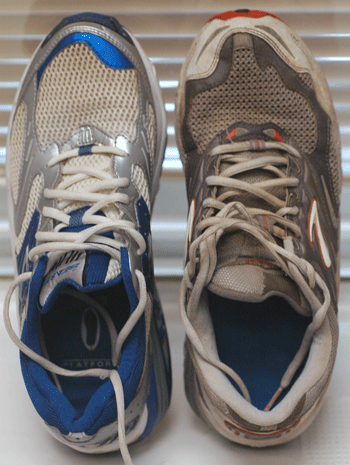
Unfortunately, a quick comparision of 2006 vs. 2007 models shows considerable differences between the same brand name shoes. Today’s runner, started feeling the pain, with his new shoes.
brooks.gif

Not only is this years model (blue) narrower, it also has a less thick (shock absorptive) outsole and a less deep toe box.

brooks3.gif

For many people wearing Brooks Beast, the above changes won’t make much of a difference and this shoe will still be fine. If you have ball of the foot pain though or need a deeper shoe, then these design changes may mean the difference between comfort and pain.

Even though a shoe keeps the name, you always want to compare it to the prior model, as design changes may help a shoe company’s bottom line, but not necessarily your foot.

Flip Flops Can Flop If Not Snug Enough

If you wear flip flops or thong style sandals, you need to pay attention to the depth of the straps. These two pair of sandals were brought in today – for the same foot, even though they are complete opposites in terms of design.

flip_flops.gif

Notice how the sandal staps on the left are high and the ones on the right aren’t? Even with a casual flip-flop, you need to match the volume of the shoe to the volume of your foot. In this case, the flip-flop on the right was a perfect fit for a shallow (flat) foot, whereas the left style was much too deep.

If the shoe doesn’t fit snug, you’ll wind up gripping you toes to keep the shoe on, which may cause hammertoes and that’s not good for your toes or feet.

High Heels – Too High

There is nothing wrong with high heels, as long as they fit correctly and the heel height is not too high. In general a high arched foot, needs a heel height of 3 inches or less, whereas a flat foot should not go above 3.5 inches.

corn_heel_shoe.gif

This is a Jessica Simpson ‘Bacton’ shoe worn in today, which contributed to the buildup of a corn in-between this persons 4th and 5th toes. This particular pair is 3 3/4″ high, much too high for this person’s high arched foot, in spite of an otherwise perfect fit.

A heel too high for your foot type, even if the fit is perfect, will always slide your foot forward, pushing the widest part of your forefoot into the narrowest part of the shoe. In this case, corns, hammertoes, bunions and ball of the foot pain are a virtual certainty because the heel is too high.

Pinch Test – Shoe Toebox

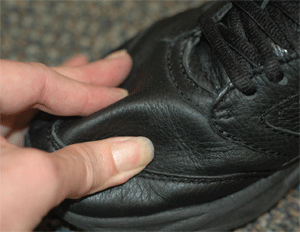
A pinch test can be done for body fat, now I’m going to teach you how to do a pinch test for your shoes. Below is a shoe that someone wore in today.

pinch_test1.gif

Not surprisingly, she hated these shoes, but has been wearing them for the past 6 months, because her podiatrist recommended them. Never mind that her podiatrist never measured her feet or had her bring in an assortment of shoes. Trustingly, this patient did what her podiatrist recommended, which was to wear these shoes which were too deep and too wide for her narrow feet.

If you are having foot or ankle pain, your shoes should fit snug to your feet, everywhere, including the toebox. If you can pinch a fold of upper in the toe-box area, then the shoe is too deep for you, no matter what anyone says.

Shoe Review – Crocs

Yes, I know Crocs clogs have been all the rage for quite sometime. Yes, they’re lightweight and slip on and off easily, which are all big plusses for those of us who hate tying our shoe laces.

The problem is, for most of us, they’re WAY too big. And if you have a narrow foot – don’t even think about buying this particular style.

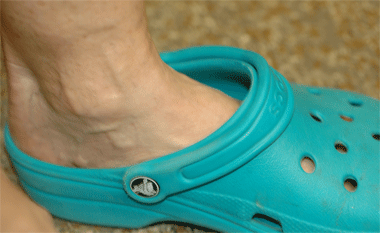
crocs.gif

If you’re foot fits in your Crocs like this foot, then you may be doing more harm than good. In the above picture, even thick socks won’t help you keep the shoe on.

A foot that fits properly in a shoe, should be going straight ahead, not side to side, and not up and down, which is what the foot in the above shoe does. The result – callous, forefoot and even heel pain, all because the clog doesn’t fit right.

Good Dog, Bad Dog Walking Shoes

If you are engaging in any activity which requires prolonged walking, hiking, standing or jumping, you should be wearing

  1. A shoe that fits
  2. A shoe that provides support.

The owner of these Merrell clogs needed shoes she could get on easily, because her jumping Labradoodle, anxiously greeted her whenever she started getting ready for their walk.

merrill_labradoodle.gif

The only problem is, the easier the shoe goes on, the harder your feet have to work to keep them on, especially if they’re too big. The end result is a happy dog and unhappy feet.

In this case – plantar fasciitis. Notice how the heel counters (back of shoe) are collapsing? This collapse is called pronation and pronation can cause plantar fasciitis. If your foot has pain, the shoes more than ever have to fit right.

Straight Lacing – Heel Slippage

This method of lacing is called straight lacing. For many oxford style shoes, this form of lacing doesn’t allow sufficient tightening in the set of eyelets, furthest away from the lace ends. Without a snug fit here, heel slippage will occur.

straight_lacing.gif

A better way to lace your heel slipping oxfords, is the good old fashioned criss-cross way. A little less fashionable, but much more secure at the toe end, which is where you need it.

criss_cross_lacing.gif

Shoe Lacing – Narrow Feet & Hiking Boots

Narrow feet have a hard time when it comes to hiking boots. Most hiking boots are made wide and deep, making it hard for narrow feet to get a snug fit.

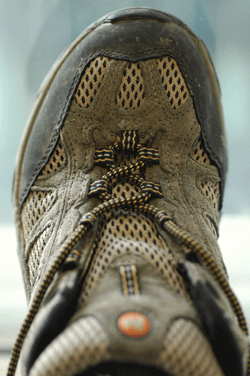
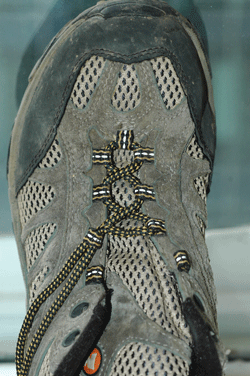
One way you can get the ankle support you need is to modify the lacing as follows. It’s easier than it looks if you follow each step.

lace_1.gif

1. Undo all the laces except for the 1st 2 or 3.

    lace_2.gif

    2. Instead of crossing over to next upper eyelet, re-lace parallel and into the adjacent eyelet

      lace_3.gif

      3. Repeat with side lace, same as above. Laces should criss-cross at this point

      lace_4.gif

      4. Pull both laces snug

      lace_5.gif

      5. Continue remainder of lacing as usual

      Now, the laces which would otherwise slide because the eyelets are loops instead of holes, are secure and snug.

      Shoe Review – Brooks Adrenaline

      This week I recommended Brooks Adrenaline running shoes to three different runners, each having narrow, shallow feet. One runner was a female, the other two runners were male.

      Not surprisingly, each runner had a different injury (neuroma, Achilles tendonitis, plantar fasciitis), which wasn’t getting better, because their running shoes didn’t fit right . For these anatomically challenged feet, few running shoes fit.

      Most running shoe uppers are made too wide and/or deep for narrow feet. Unfortunately, this is true, even if the running shoe is sized in a narrow width. Given this frustrating state of affairs, what’s a narrow foot to do?

      Enter Brooks Adrenaline GTS to the rescue…

      brooks_bottom_2.gif

      brooks_side.gif

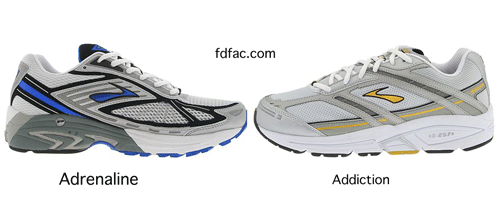
      On the left is the Adrenaline and on the right is the Addiction. Even though both shoes are made by Brooks and both are sized medium width, they are entirely different shoes. The Adrenaline is narrow and shallow. The Addiction is wide and deep.

      If your foot is narrow and you are a runner, then the Brooks Adrenaline is definitely a shoe you should try. Women with narrow feet usually do better in a 2A width and men with narrow feet usually do better in the D width of this shoe. Unsure of what width to get, try both in narrow and medium and let your feet decide!

      When Heel and Ball of the Foot Pads Don’t Work

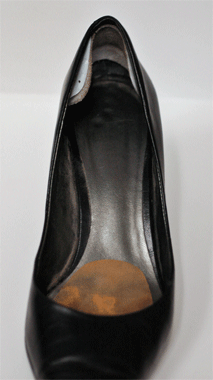
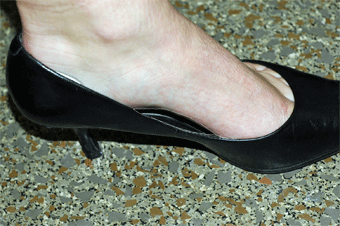
      Whenever high heels walk into my office with the insides padded to the 9’s it’s almost guaranteed, that the shoe isn’t fitting properly. Possible causes:

      1. Shoe heel height is too steep and you’re sliding forward, losing arch support and contact.
      2. Shoe is too short and all of your body weight is crashing down onto the ball.
      3. Shoe is too deep in the toebox and you’re sliding forward
      4. Sides of shoe are too gappy and you’re not being held secure.
      5. You have a high arch and the instep of the shoe is below your arch’s instep.

      stuffed_heels.gif

      This problem with this shoe was #5. In this case, heel and forefoot padding were insufficient to keep her foot in the shoe.

      cavus_over_instep.gif

      Heel Slippage: Foot Width, Foot Depth

      Heel slippage generally happens when a shoe is too wide or too deep or both. Rarely do people think about depth when buying shoes. You can have a wide foot without much depth (flat foot), or you can have a wide foot with a lot of depth (high arch). Even if both feet are the same size and width, they wouldn’t be able to wear the same shoe.

      Here’s an example of different depth shoes. The shoe on the left is shallow and the one on the right is deep, even though they are the same size and style.

      depth.gif

      If you experience heel slippage, then you probably need to look at shoes from the side as well as the top. Shallow feet need shallow uppers or they will slip in the heel.