Shoe Review – Chaco Sandals

If you have a wide foot that’s either deep or shallow then Chaco sandals (http://chacousa.com/) may be just right for you. They have a thick sole with a built in arch, which is great for flat or collapsing feet.
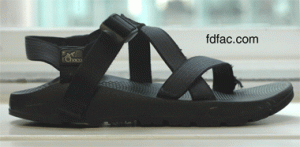
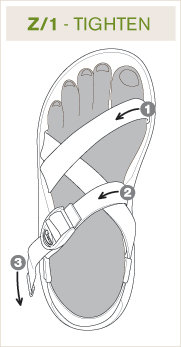
My favorite part of the shoe though, is how easily it adjusts by sliding the straps to increase or decrease depth. This makes for a better customized fit, then if you just had width adjustability alone.
Another added bonus is their repair program, which includes all parts of the sandal from strapsto soles. At around $100 for the sandal and $30 for the repairs, Chaco sandals can last years. And don’t your feet deserve that?


Shoe Review – Newton Running

A marathon runner came into the office asking about the new Newton Running shoes. He had seen their booth at his last Marathon event and wanted to try them, so he purchased a pair online and brought them in.

I was disappointed when I saw them, not only because of the expensive price tag ($150+) but because they were unstructured and flexible, reminding of Nike Free. Most discouraging of all though, was watching JR run in them on the treadmill. The upper was moving from side to side to the point that I was worried about rearfoot injury and the potential for knee pain with continued use.

Needless to say, he looked much better in his Saucony Grid Stabil’s which held him in proper alignment. If you are interested in running in a Newton, make sure you have a sports medicine specialist evaluate them on you including running.

Thierry Rabotin Designer Shoes

Arthur Beren in San Francisco http://www.berenshoes.com/ is the place to go if you are stylish and don’t mind spending $400 (or more) on a pair of shoes, including Thierry Rabotin. Previously a designer for Taryn Rose, he now has his own line which many of the well heeled wear. Butter soft leather uppers and insoles the color of Tiffany box blue. Genius marketing…if only I’d though of it!

Today someone brought in two pair of Thierry Rabotin shoes which perfectly fit her wide (bunion), shallow, hard-to-fit feet. This pair is “Grace”, a ballerina flat with an elasticized vamp insets which help with the fit. Stylish and fun. If you can afford the sticker shock, Thierry Rabotin is a great designer shoe line.


Shoe Review – Asics 2130 New vs. Old Differences

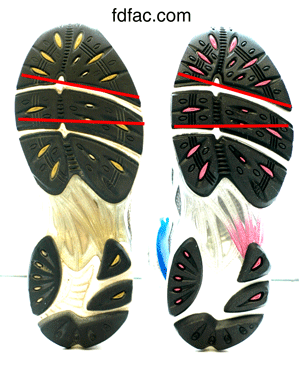
Asics 2130 is one of my favorite shoes and I recommend it daily. Today however, someone brought in a pair of the new 2130’s in the storm/lightening/hot pink color. Her previous pair were the white/gold/python color and much to my dismay, the shoes were not the same width.

The new 2130’s (right) were 5mm narrower than the old 2130’s (left), which makes the fit more like the old 2120’s which have been discontinued.

If this is your running shoe, make sure you check the width as subtle changes can make a big difference. If the new 2130 seems too tight, switch to the D width which will probably work.

Shoe Review – MBT’s (Masai Barefoot Technology)

Reader Joey asks “I need professional, non-biased opinions on the MBT’s”.

I reviewed MBT’s, on my 12/22/07 posting. Here’s the link: https://drshoe.wordpress.com/2007/12/22/cnettv-me-on-masai-barefoot-technology/

As an additional summary, I’m not a huge fan of MBT’s because they are heavy and expensive and don’t work at all for narrow or shallow feet.

Research the company cites to validate their findings were done on healthy college students, having little or no pathology. Not surprisingly, there have only been three studies, all sponsored by the company and none within the past several years.

Typically when someone comes into the office wearing MBT’s, I work with them to transition out of the MBT’s into a more normal type of shoe and I have never recommended MBT’s as a first line of treatment.

Wedge Sandals – Added Height without Added Pain

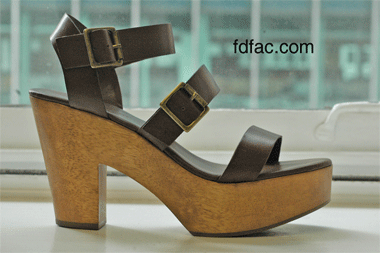
Ebony brought in this great platform wedge sandal today, purchased from Gap.

Platform style sandals are a great way to add height without increasing ball of the foot pain. This sandal has the added bonus of buckles at the ankle and over the top of the foot for even better fit. All in all this shoe rates an A for summer style and wear.

Shoe Review – NikeiD

Okay, I’m not going to really review all the different NikeiD styles because there are so many of them. Instead, what I wanted you to know, is how much fun the NikeiD process is.

Basically, you pick the shoe design, the colors and some of the materials which make up the shoes. For example – upper color, logo color, insole color and shoelaces.

The above image shows a pair brought in today ($110), which are fun and original. This is the Nike Dunk Low iD Men’s Shoe and it’s surprisingly stable compared to similiar shoes like Vans.

Public Radio – Body Language Interview: 91.7 KAWL

Dear Readers,

In the next week I’ll be doing an interview, which will air in July, for Body Language, a new public radio show featuring contemporary attitudes towards health and wellness. http://www.onthepathproductions.com/

Part of what I’ll be doing is talking about the blog, including common shoe misconceptions as well as what it takes to keep your feet healthy and happy for years to come.

In preparation of the interview, I thought your input would be helpful, so I’d like to have you answer the following questions on the blog. If you would prefer to keep you’re answers anonymous, just let me know and I won’t post them.

  1. What’s the worst shoe advice you ever got?
  2. Are you a slave to comfort or fashion. Can you have both?
  3. How much money have you spent on shoes you can’t wear?

Thanks and if there is anything else shoe wise that you would like me to blog about, let me know, I love hearing from you!

Dr. Sanders

Shoe Review – FitFlops

Reader and Medical Student Tony asks “What do you think about the FitFlop?”.

I think FitFlops are great. They have nice wide straps and a thick, contoured soles. I have used them successfully with narrow, shallow feet (Wiley’s Felt Remedy required) and wide, deep feet. I don’t however believe the company’s claims about muscle work-outs, toning and trimming of the legs so don’t buy them for this reason.

If you’re looking for a fun, comfy, well designed, well made and well fitting flip flops, then FitFlops may just be for you.

Shoe Review – New Balance 768

Reader Andrea asks “Could you please review the New Balance 767? I have a relatively narrow foot and wear orthotics for my high and collapsing arch.”

I’m not familiar with the NB 767 model, but I am familiar with the 768 which is the next version. My problem with the 768 is it has a very deep toe box even in the narrow width.

On the plus side – it will work with an orthotic and it won’t strangulate your high arch. Just make sure it doesn’t fail the pinch test: https://drshoe.wordpress.com/2008/01/15/pinch-test-shoe-toebox/

If it does, then you might want to try Asics 2130 in medium, since this has a shallower toe box, fits the narrow foot with a high arch nicely and will work with an orthotic.


Sandals With Adjustable Straps

With summer almost here, many of us will be switching to sandals. For those of us who have developed the bad habit of slipping our sandals on and off without tightening…Stop It.

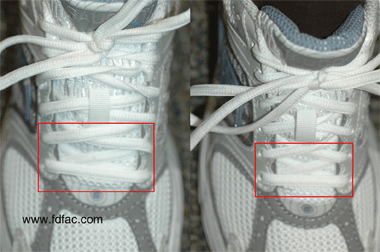
Not to sound like your mother, but shoes which adjust (tie, buckle, Velcro) need to be snugly secured each and every time you put them on. If you don’t do this, then you’ll experience excessive heel slippage and toe gripping, which can cause hammertoes and blisters to name just a few.

Here is a wedge sandal which was typically slipped on and off. The image on the left shoes proper fit and the image on the right shows sloppy fit. Which version would you rather wear?

Men’s vs. Women’s Shoe Sizes (Brannock Device)

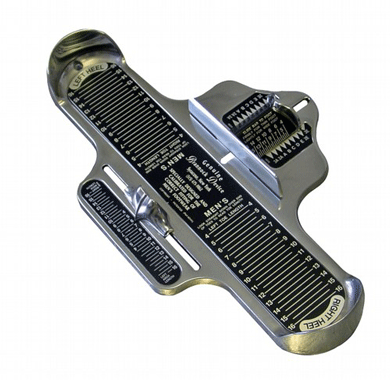
In the 1920’s, Charles Brannock invented a measuring device, which bears his name and is still used today in most retail shoe stores.

According to the Brannock Device, men’s shoe sizes are one size larger than women’s. For example a men’s size 9 shoe would fit a woman’s size 10 foot. The size increments for both are 1/3″ difference between each size. So if you need to go up or down a half size, you’re only changing the size by 1/6″. Not nearly as much as most of us think.

There is also a nifty conversion chart on the Brannock Device’s website which differentiates different sizing systems, including children and European sizes as well.

Here’s the link http://brannock.com/cgi-bin/start.cgi/brannock/charts.html

Shoe Cleats – Beware of Wear

If you play a sport which requires wearing cleats (soccer, baseball, football, golf) then you want check your cleat wear regularly.

Here’s a pair of turf soccer cleats, which are about a year old. As this image shows, the heel cleat on the right shoe is still flat, causing a pivot point and a protrusion force upward as compared to the heel cleat on the left shoe, which is evenly worn with the other cleats.

In this case, the cleat on the right shoe actually caused plantar fasciitis – heel pain, which could have been avoided if the shoes had been replaced before the cleats started to wear asymmetrically.

High Heels Having Same Heel Height – Boots vs. Non-Boots

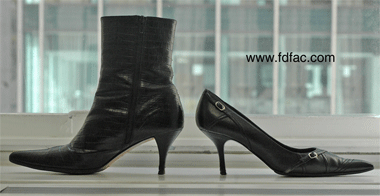
Given a choice between two pair of high heels with the same heel height, one boot and one non-boot, the boot will always win (given the same width).

A boot keeps the foot better aligned with the ankle, which increases stability, reduces wobble and allows for more comfortable walking.

If you’ve got a night out on the town of club hopping and dancing – then a boot will always be a better choice.

Shoe Review – La Sportiva Trango Trek GTX

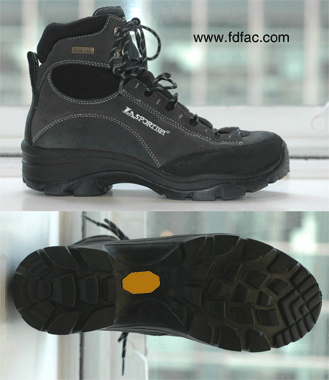
Thanks to Bill for bringing in this pair of hiking boot today. This is a great boot if you have a narrow, deep foot. Vasque is for a narrow shallow foot, whereas LaSportiva is for those feet having slightly more volume with a narrow width.

This is a sturdy hiking boot good for variable terrain including lots of hills. It also cinches up tight for narrower ankles.This boot can be found at REI and several other retailers for around $180.

Heel Slippage – Improper Shoe Lacing

When heel slippage happens, most people intuitively tighten their shoe laces at the ankle, which won’t help with slippage. The laces which need to be laced the tightest are the furthest away from the ankle.

It’s a bit of a pain, but each and every time you lace your shoes, you’ll want to start at the toes and progressively cinch up until you reach the ankle.

When lacing shoes with heel slippage, 9 times out of 10, lacing correctly will ensure a snug fit. You will also want to relace your shoes, when wearing an orthotic for the first time.

Shoe Sizes Beyond 12 (men) or 11 (womens)

If you wear a men’s shoe greater than size 12 or a women’s shoe greater than size 11, you will have difficulty shoe shopping. Why? Because a bigger size means more inconsistency in width, length and depth.

Bigger sizes also usually don’t have half sizes, which makes finding the right fit even more dififcult.

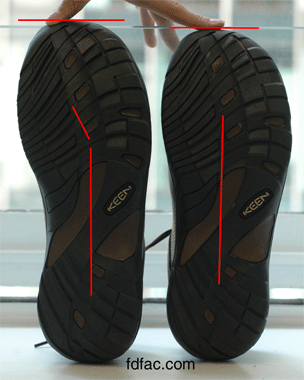
Here are two pair of the same Keen shoes. A size 13 on the left and a size 12 on the right.

Notice how the size 13 is longer and more curved? This is clearly not one size larger, since a full size should only be 1/3″.

Bottom line, if your size falls into this category, you’ve got to pay particular attention to sizing and fit.

Shoe Review – Asics 2120

This is one of my favorite shoes for shallow (narrow or wide) feet. Added bonus, it’s also very stable, with a firm heel counter (back of heel) and great torsional stability (doesn’t twist).

This shoe is narrower than the 2130 or the Gel Kayano. It’s also works if you have a wide foot or a foot with a bunion.

I recommend this shoe at least once a day. Only problem is, the women’s narrow (2A) size is almost impossible to find and doesn’t work too well with an orthotic because it’s too narrow for an average sport orthotic to fit in. The men’s narrow (B) easily accomodates an orthotic and has fit every narrow, shallow foot I’ve fit, perfectly.

Running Shoes – Making an Orthotic Fit

Blog reader Cherilyn asks I am trying to find a running shoe that accommodates my orthotics; a shoe with a deep foot-bed. Do you have any recommendations?”

Since prescription custom orthotics should match your foot, then if your foot matches your shoe, so too should your orthotic. Also, a custom orthotic made by a sports medicine podiatrist, is never as wide as your foot anyway, so there shouldn’t be any problem fitting it into a running shoe.

If you can’t get your orthotic into your running shoe, then either your shoe fit is wrong (length, width, depth), or your orthotic is wrong. Once made, an orthotic should work in all similar styles of shoes. For example an orthotic which fits into a pair of Asics 2130 should also fit into a pair of Brooks Adrenaline. A sport orthotic on the other hand will usually not fit into a non-athletic shoe, (flats, loafers), because of lack of room.

Most of the running shoes I’ve featured on my blog work great with orthotics. Saucony, Brooks, Asics, New Balance, Adidas and Nike all have lots of styles, which when fit properly will absolutely accommodate an orthotic.

Nordstrom San Francisco – Steve Brown, Men’s Shoes

When in San Francisco looking for men’s shoes, look no further than Nordstom San Francisco Center and Steve Brown. Steve is one of those rare career shoe salesman, who is more interested in making sure your shoes fit right than in commission.

Working in men’s shoes for nearly three decades, Steve knows feet and he knows men’s shoes. I trust my family with him. I trust my patient’s with him. What more can I say than that? Call ahead for his hours and days working.

Nordstrom San Francisco Centre
865 Market Street
San Francisco, CA 94103
(415) 243-8500