Category Archives: Foot Pain

Painful 5th Toes, Running Shoe Must Haves

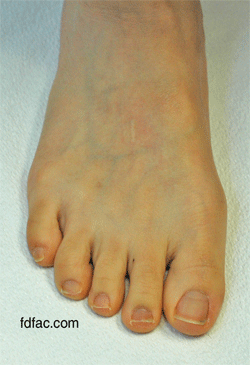
Many people have curled 5th (pinky) toes. This rotation, usually causes the outside of the toe to become prominent. When this happens, your shoe rubs against the protrusion, creating friction against the skin overlying this area. This friction will cause pain, and occasionally, it will form a corn (hard callous).
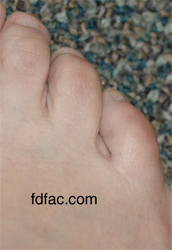
5th_toe_turn2.gif

If your 5th toe is usually crowded in running shoes, you need to pay attention to your shoe design, and more importantly, you’ll want to find running shoes, having mesh over the painful outside spot.
corn_2.gif

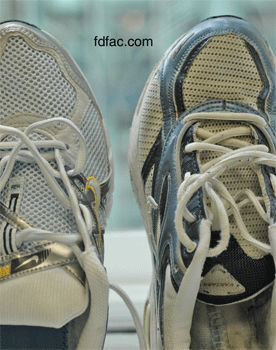
These two different pair of Nike running shoes were brought in today. The shoe on the left caused 5th toe pain while the shoe on the right did not. The difference is the mesh placement. The left shoe’s trim extends onto the toe, whereas the right shoe trim is much lower and the mesh is in exactly the right place.

corn_5th.gif

Looking at the side view, you can also, easily see the difference. Even though the shoe on the left had a deeper toe box, it still caused pain because the mesh and trim were in the wrong place.

If you have a bunion, hammertoes, or a curled 5th toe, you’ll want to find shoes with mesh in the right place.

Shoe Review – Brooks Beast

Brooks Beast is a tank. Great for those of us with wide, deep feet. Slightly heavy, torsionally stable (no lengthwise twist), with a heel slightly wider than the forefoot.

I must say, however, I was disappointed to see the change in this years model, compared to prior years. Today, someone came in having ankle and ball of the foot pain, which didn’t happen with his prior year Beast models.

Unfortunately, a quick comparision of 2006 vs. 2007 models shows considerable differences between the same brand name shoes. Today’s runner, started feeling the pain, with his new shoes.

brooks.gif

Not only is this years model (blue) narrower, it also has a less thick (shock absorptive) outsole and a less deep toe box.

brooks3.gif

For many people wearing Brooks Beast, the above changes won’t make much of a difference and this shoe will still be fine. If you have ball of the foot pain though or need a deeper shoe, then these design changes may mean the difference between comfort and pain.

Even though a shoe keeps the name, you always want to compare it to the prior model, as design changes may help a shoe company’s bottom line, but not necessarily your foot.

High Heels – Too High

There is nothing wrong with high heels, as long as they fit correctly and the heel height is not too high. In general a high arched foot, needs a heel height of 3 inches or less, whereas a flat foot should not go above 3.5 inches.

corn_heel_shoe.gif

This is a Jessica Simpson ‘Bacton’ shoe worn in today, which contributed to the buildup of a corn in-between this persons 4th and 5th toes. This particular pair is 3 3/4″ high, much too high for this person’s high arched foot, in spite of an otherwise perfect fit.

A heel too high for your foot type, even if the fit is perfect, will always slide your foot forward, pushing the widest part of your forefoot into the narrowest part of the shoe. In this case, corns, hammertoes, bunions and ball of the foot pain are a virtual certainty because the heel is too high.

Pinch Test – Shoe Toebox

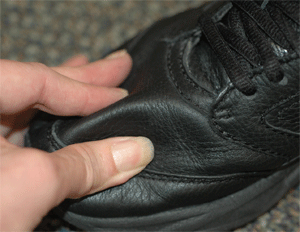
A pinch test can be done for body fat, now I’m going to teach you how to do a pinch test for your shoes. Below is a shoe that someone wore in today.

pinch_test1.gif

Not surprisingly, she hated these shoes, but has been wearing them for the past 6 months, because her podiatrist recommended them. Never mind that her podiatrist never measured her feet or had her bring in an assortment of shoes. Trustingly, this patient did what her podiatrist recommended, which was to wear these shoes which were too deep and too wide for her narrow feet.

If you are having foot or ankle pain, your shoes should fit snug to your feet, everywhere, including the toebox. If you can pinch a fold of upper in the toe-box area, then the shoe is too deep for you, no matter what anyone says.

Shoe Review – Crocs

Yes, I know Crocs clogs have been all the rage for quite sometime. Yes, they’re lightweight and slip on and off easily, which are all big plusses for those of us who hate tying our shoe laces.

The problem is, for most of us, they’re WAY too big. And if you have a narrow foot – don’t even think about buying this particular style.

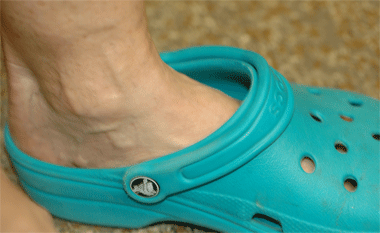
crocs.gif

If you’re foot fits in your Crocs like this foot, then you may be doing more harm than good. In the above picture, even thick socks won’t help you keep the shoe on.

A foot that fits properly in a shoe, should be going straight ahead, not side to side, and not up and down, which is what the foot in the above shoe does. The result – callous, forefoot and even heel pain, all because the clog doesn’t fit right.

Good Dog, Bad Dog Walking Shoes

If you are engaging in any activity which requires prolonged walking, hiking, standing or jumping, you should be wearing

  1. A shoe that fits
  2. A shoe that provides support.

The owner of these Merrell clogs needed shoes she could get on easily, because her jumping Labradoodle, anxiously greeted her whenever she started getting ready for their walk.

merrill_labradoodle.gif

The only problem is, the easier the shoe goes on, the harder your feet have to work to keep them on, especially if they’re too big. The end result is a happy dog and unhappy feet.

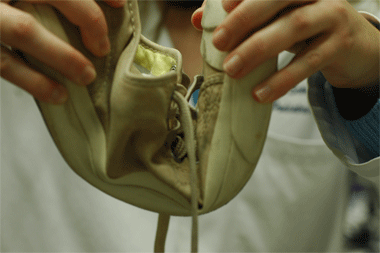
In this case – plantar fasciitis. Notice how the heel counters (back of shoe) are collapsing? This collapse is called pronation and pronation can cause plantar fasciitis. If your foot has pain, the shoes more than ever have to fit right.

Sole Design for Hallux Limitus and Rigidus

Hallux limitus as the name implies, is a limitation of the up and down motion of the great toe joint. Hallux limitus usually causes a bump closer to the top of the joint as opposed to the inside, as seen with a bunion. Hallux rigidus is a more advanced form of limitus, resulting in no motion at the big toe joint.

turf_toe.gif

The bump is usually a result of bone spurring. The pain occurs when the toe goes up, which causes the spur to rub against the adjacent bone.

An inflexible forefoot sole is a must for these types of feet. Fortunately this patient’s running shoe flex grooves didn’t flex at the big toe joint. This is good, because it helps to reduce joint motion and absorb shock.

flex_grooves.gif

Unfortunately, his pair of Converse All Star kick-a-rounds, twisted like a pretzel. Definitely not a good idea for restricted joints.

torsional_unstable.gif

If you have hallux limitus, watch your shoe’s forefoot flexibility. The greater the flex, the worse the pain. I have added another post about hallux limitus here https://drshoe.wordpress.com/2008/10/30/hallux-limitus-vs-hallux-rigidus/

Shoe Review – Dansko Clogs

Dansko clogs are great for lots of painful foot conditions providing your foot is the right type. If you have pain in the balls of your feet (metatarsalgia), Dansko clogs are terrific because they don’t flex. People having plantar fasciitis (arch/heel pain), can also benefit from Dansko clogs, because of their built in arch support and torsional stability.

However, if you have a narrow or shallow foot, then this is not the shoe for you. Even if you buy the narrow width version, they will generally still be too deep, for a narrow foot.

If on the other hand you have a wide foot or a medium height arch, then this is a great shoe for you.

The following young woman came into my office today having plantar fasciitis, wearing Dansko clogs. Even though she has a wide forefoot, her overall foot depth is flat and shallow. In her case, she was swimming in the clogs, especially on the right side, which had the arch pain.
sherise_barefoot.gif

dansko_clogs.gif

Because of the excess room and heel slippage she was experiencing in the above Dansko clogs, I showed her several pair of non-Dansko clogs on Zappos. com, that will give her the extra height she’s looking for, without adding excess depth in the vamp.

When Heel and Ball of the Foot Pads Don’t Work

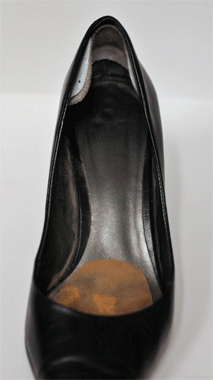
Whenever high heels walk into my office with the insides padded to the 9’s it’s almost guaranteed, that the shoe isn’t fitting properly. Possible causes:

  1. Shoe heel height is too steep and you’re sliding forward, losing arch support and contact.
  2. Shoe is too short and all of your body weight is crashing down onto the ball.
  3. Shoe is too deep in the toebox and you’re sliding forward
  4. Sides of shoe are too gappy and you’re not being held secure.
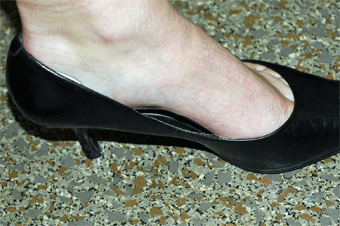
  5. You have a high arch and the instep of the shoe is below your arch’s instep.

stuffed_heels.gif

This problem with this shoe was #5. In this case, heel and forefoot padding were insufficient to keep her foot in the shoe.

cavus_over_instep.gif

CNetTV & Me on Masai Barefoot Technology

I oftentimes am asked to comment on new shoe technology. Kara Tsuboi of CNet TV did a story on Masai Barefoot Technology (MBT’s) and interviewed me. Here’s a link to her video, where opinions, fact and fiction are explored.

http://www.cnettv.com/9742-1_53-31862.html

mbt.gif

My Masai Barefoot Technology review – MBT’s are heavy, wobbly, expensive and don’t work for every foot type (especially narrow) And, if you’re younger than 30, I doubt you would find them suitably fashionable to wear on your feet.

Bunions – Running Shoe Must Haves

At least once a day, I treat someone having a bunion, wearing the worst possible running shoe. By worst possible, I don’t mean brand, because there’s no such thing as the perfect brand. What I mean is, design, or rather the shoe design features to look for in a shoe which will maximize wear ability and comfort.

For those of you with bunions, finding a running shoe that’s wide enough can be a frustrating challenge. Because of this, you oftentimes wind up buying a shoe that accommodates the bunion, but doesn’t fit the rest of your foot.

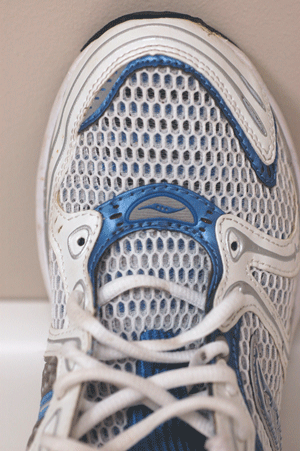
The better solution is to look for mesh over the bump and eyelets that extend to the bump or beyond. This way, the shoe is forgiving where your need it, without sacrificing proper fit in the rest of the foot. You can also skip the first pair of eyelets to instantly increase forefoot width as well.

Here is an example of what to look for.

saucony_eyelet_hav.gif

Notice the mesh which pushes out where the bunion is? After doing this, if the shoe still feels snug, you can also skip the first set of eyelets to relieve even more pressure over the bump.

Heel Slippage: Blisters & Bloody Heels

heel_slippage_blister.gif

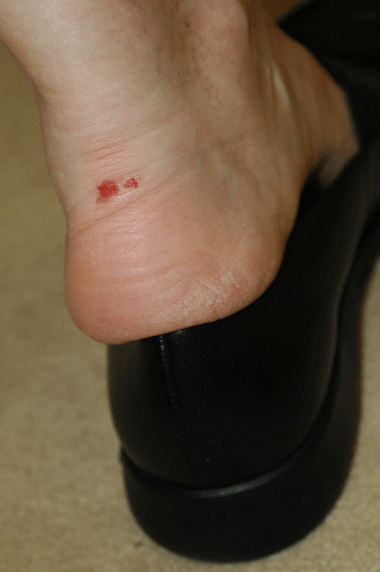
How many of us excitedly wear our brand spankin’ new shoes for a special day or night out and we wind up with bloodied, painful heels because of the shoes?

If this is you, then chances are the shoe isn’t form fitting snugly enough which results in your foot moving up and down. Couple this friction with sweat and a stiff heel counter and you’ve created a recipe for pain.

Fortunately, here’s what you can do.

  1. Make sure your shoe fit snugs. Noticeable heel slippage in the shoe department will inevitably lead to blisters if the heel counter leather is stiff.
  2. If you’re prone to heel slippage (narrow or shallow feet), avoid any slip on styles that don’t adjust in the vamp, ie. straps, buckles and Velcro.
  3. If your heels still slip, use a tongue pad or custom cut out a tongue pad from Wiley’s Felt Remedy.

Now what if I’m too late and the blisters have already formed?

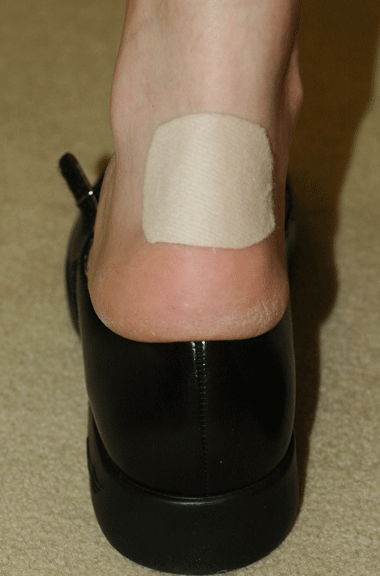
  1. Cut a generous square, with rounded corners of moleskin and completely cover the blister(s) so that it is visible above the counter of the shoe.
  2. Let the moleskin wear off on it’s own. Don’t pry off or the adhesive will take the top of the blister with it.
  3. Band-Aids aren’t big enough to help. You need t o custom cut the moleskin to ensure coverage.

heel_blister_moleskin_1.gif

heel_blister_moleskin_2.gif

Size Matters (Heel to Ball vs. Heel to Toe)

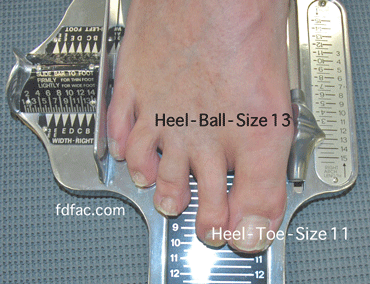
Almost everyone who comes into my office, gets their foot measured. Why? Because wearing the wrong size shoe can cause pain and most people have no idea what their foot size really is. When was the last time you had your foot measured? Do you know the difference between to heel to toe and heel to ball? You should…it’s important, and it can mean the difference between comfort and pain.

The following pictures illustrate these two different foot measurements. The first person’s foot measures a 13 (heel to ball) and the 2nd person’s foot measures a 7.5 (heel to toe). Some of us have a longer heel to ball measurement and some of us have a longer heel to toe measurement. Whichever measurement is longer (heel to toe or heel to ball), that’s what size you are.

heel_ball.gifheel_toe.gif

Bunion Pain

For those of you with bunions, it’s important that your shoe not constrict around the bump. Things to avoid over the bump include – Decorative trim, stitching or anything unforgiving. Today’s shoe is an example of what not to wear.

bunion.gif

Excessive Wear

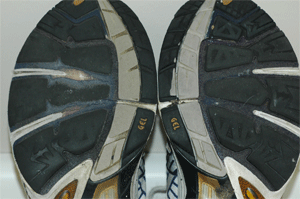
outsole_wear.gif

Neuroma (burning forefoot) pain, right foot, only when working out. Shoe review identified the following two problems.

Problem Number 1: Shoes are 1 size too short. This causes the widest part of the forefoot to be forced into the tapered part of the shoe, kinda like a vice-grip.

Problem Nunber 2: Paper thin outsole, right shoe, which corresponds to foot having pain. No difference between a worn outsole and being barefoot. No wait… thin outsole coupled with the wrong size, it’s worse than being barefoot in the gym!

Pump Bump/Haglund’s Deformity

If you’re a male, a protruding bump at the back of the heel bone is called Haglund’s Deformity. If you’re a female, it’s called a Pump Bump. They’re both the same thing and represent excess bone forming at the back of the heel, usually because of lower leg alignment. Essentially, what happens is the the heel bone fishtails across the back of the shoe, with repetitive friction causing excess bone to form.

dsc_0002b.gif

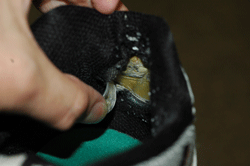
For most of us an enlarged Haglund’s or Pump Bump is harmless, but for my patient, seemingly out of nowhere, the bump started to become increasingly red and painful. Dress loafers were not the culprit, so I asked to see his workout shoes and this is what I discovered.

dsc_0007b.gif

The inside heel area of his shoe was not only excessively worn but the plastic counter had actually cracked, essentially rubbing his heel bone raw.

The solution? New shoes with careful monitoring of wear and possibly even a shoe with a soft heel counter, depending on future wear.

Running Shoes – Forefoot Outsole Flex Grooves

A runner came in today with a moderately worn pair of Asics running shoes. Having solved her left heel pain with orthotics some time ago, she was now in my office because she started having increasingly painful ball of the foot pain during her runs.

A quick runway walk down my hall in her Asics shoes showed a stable rearfoot with no excessive pronation in site. Her orthotics were performing like a dream, so that couldn’t be it…what then? Had she changed her mileage or running surface?…No. Had she started to run at a different time of day?..No.

I thought to myself, there had to be a hidden clue – something telling about her shoes. And for me, this is where the fun comes in. I had her shoes off in a flash and got to work. Bending, flexing and twisting her shoes. Vertical heel counter – check. Proper volume – check. Mesh over her bunion – check. and then I saw it, like a lazy snake in the grass. What about the shoes outsole flex point? Could that be the problem? Yes, yes, yes!

Sure enough, when I had her put the shoes back on, I realized that the ball of her foot lay directly over the flex point. Furthermore, this area had no overlying rubber on the outsole and was simply soft EVA, which is pumped full of air for lightness but not necessarily shock absorption. Aha, that was it, the shoe was bending up at at the forefoot flex point, which hammered the ball of her foot against the ground.

This was confirmed by the fact that I had her bring her prior running shoes in which had two flex points instead of one. And neither flex point on the old shoe was centered across the ball of her foot. Another shoe success story, another injury averted and another happy patient.

Take home message – New onset foot pain is not normal. First check the feet and if they’re fine, then check the shoes. Every little thing counts, and you have to be your own best advocate and intimately get to know your shoes.