Category Archives: Orthotic Friendly Shoes

Motion Control Shoes and Orthotics

Reader Rick asks “If I have flat feet, should I wear an orthotic, or wear a motion control running shoe? Or, can I have both or will this cause too much stability and actually make me a supinator?”

It all depends on whether or not you are having problems. If your foot is just flat, than a motion control or certainly a wider outsole shoe would be recommended for you. Motion control shoes usually have a firm heel counter (non-collapsible) a stiff footbed below the sock liner and a firm EVA midsole, which are all designed to prevent excessive pronation (foot collapse inward).

What a motion control shoe may or may not have is a stable upper, which is also necessary for proper support and pronation control. If your podiatrist determines you need an orthotic (excessive pronation), a motion control shoe can help, but you will still need the orthotic.

Don’t worry about the shoe and the orthotic causing supination (turning outward) as the combination won’t have that effect. Worst case scenario, you will have more control than you need, but this shouldn’t be a problem.

Shoe Review – Nike Air Max Assail Trail

Finding a trail shoe for a narrow foot is not an easy task. The Nike Air Max Assail Trail fits the bill even though it’s listed as a D-Medium width and not narrow. An added plus is torsionally stability (no side-to-side twist) and an inflexible, thick, shock absorptive sole. This can help alleviate ball of the foot pain. It will also accommodate an orthotic which is great.

Women’s Asics 2130 – Updated Colors

Women’s Asics 2130 is one of my favorite shoes. It works for narrow and wide feet, which are shallow in depth. It’s not quite as narrow as the now discontinued 2120 but it does come in a 2A width which is great.

Recently (7/08), Asics released new colors of the 2130 which is good or bad depending on what you’re looking for. The new version is slightly narrower and a 1/2 size shorter, than the older models. The new colors can be found on Zappos.com, in Black/Platinum/Cherry and Storm/Lightening/Hot Pink, which is the shoe below.

If you’re wearing the old version and purchase one of the newer colors of this shoe, carefully compare it to your existing fit. You may need to go up in size or width to get the same fit.

Shoe Review – Saucony Progrid Omni 6 Ultimate

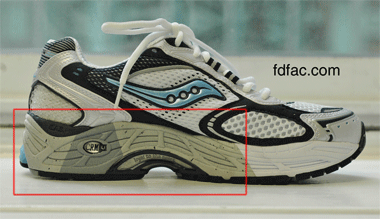
This shoe has a lot of mesh in the forefoot upper, which can help if you have hammertoes and /or bunions. The back of this shoe has a firm heel counter, which helps guide heel strike if you pronate excessively. This shoe also has firm EVA (ethyl vinyl acetate) in the midsole extending from the arch to the back of the shoe which makes it very stable.

A general rule of thumb is the darker (more grey) the outsole, the more firm or less flexible the shoe will be. This design feature helps those feet who need lots of support, especially at the rearfoot. The difference between the Ultimate and the Moderate version is the Ultimate has EVA which wraps around to the heel wheras the Moderate just has EVA in the instep.

The mens and womens version of this shoe come in medium and wide but not extra-wide and the toe-box is not too deep which can help fit considerably if your foot is wide and shallow.

Version 7 has just been released and from what I can see on Zappos.com, it looks to be essentially the same as version 6, but I’ll keep you posted if that changes. The other good news is, because version 6 is being upgraded, you can probably find this shoe on sale. At Sports Basement in San Francisco, this shoe is marked down from $100 to $64. Quite a deal for a well made shoe!

Shoe Review – Nike Air Pegasus Trail Shoe

D.M. came in today with his barely worn Nike Air Pegasus Trail shoes. He was recovering from a fractured sesamoid bone (small bone under the big toe joint) and wanted me to evaluate his shoes before he resumed running.

He had purchased the running shoes prior to his injury and spent over two hours in a specialty running shoe store, trying on every shoe in the store, because of his difficult to fit narrow foot. Finally, with the help of the sales staff, he found this Nike Air Pegasus Trail shoe. It was apparently rated highly by a runners magazine, which helped to close the sale.

The above image shows the shoe which on first glance appears moderately deep and wide, but I was keeping my fingers crossed, at least until I saw D.M. stand in the shoes.

Normally, the back area of the shoe (heel counter) should be perpendicular to the standing surface. As this image shows, the heels are turned out, which is not good for healing sesamoids, knees or alignment in general. No wonder he wasn’t getting better.

Moral of the story. Just because someone says shoe xy or z is the best shoe ever, make sure the shoe works for your foot and not someone elses. It could me the difference between healing and continued pain.

Shoe Review – Adidas 7406 Soccer Cleats

Finding a wide shoe for soccer is no simple task. Most soccer shoes fit painfully snug, so if your foot is outside of the bell shaped curve, trouble may loom ahead. I found this shoe for someone having serious ingrown nails, because of the narrow toebox fit. Luckily I found the Adidas 7406 which have a couple of great features and fit him perfectly.

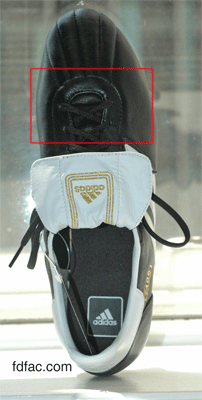
  • The eyelets extend beyond the ball of the foot, closer to the toes. This allows for width adjustability. Many soccer cleats don’t lace down this far and if your foot is wide, this can really help.

  • The arch width doesn’t hourglass in like most soccer cleats, given the arch full support as seen below.

And the overall width is slightly wider than most other soccer shoes and has a removable sock line which will accommodate an orthotic if you need one.

Shoe Review – Saucony Grid Stabil

Saucony Grid Stabil is one of my favorite shoes and I recommend it at least once a day for the narrow (rectangular) foot. Surprisingly it works for shallow (flat) and deep (high arched) feet, because it comes in both medium and wide widths. For a refresher on foot width determination, refer to my blog posting https://drshoe.wordpress.com/2008/01/14/narrow-vs-wide-feet/.

As for the construction, this is one of the few running shoes which is proportional, meaning the heel to ball and heel to toe measurements are true to size (https://drshoe.wordpress.com/2007/12/05/size-matters-heel-to-ball-vs-heel-to-toe/). It’s also deep enough to accommodate a sport orthotic once you remove the sock liner.

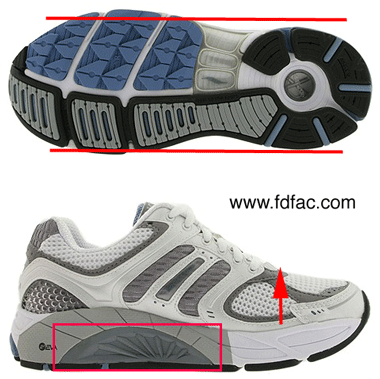
It has a non-collapsible heel counter which helps guide heel strike and it has a firm inside mid-sole (grey above) which helps with pronation or foot collapse. Lastly the toe box is shallow meaning it will pass the pinch test (https://drshoe.wordpress.com/2008/01/15/pinch-test-shoe-toebox/), providing a secure fit, if your foot is lower volume than most.

Heel Slippage – Improper Shoe Lacing

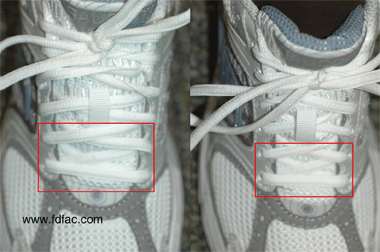
When heel slippage happens, most people intuitively tighten their shoe laces at the ankle, which won’t help with slippage. The laces which need to be laced the tightest are the furthest away from the ankle.

It’s a bit of a pain, but each and every time you lace your shoes, you’ll want to start at the toes and progressively cinch up until you reach the ankle.

When lacing shoes with heel slippage, 9 times out of 10, lacing correctly will ensure a snug fit. You will also want to relace your shoes, when wearing an orthotic for the first time.

Shoe Review – Asics 2120

This is one of my favorite shoes for shallow (narrow or wide) feet. Added bonus, it’s also very stable, with a firm heel counter (back of heel) and great torsional stability (doesn’t twist).

This shoe is narrower than the 2130 or the Gel Kayano. It’s also works if you have a wide foot or a foot with a bunion.

I recommend this shoe at least once a day. Only problem is, the women’s narrow (2A) size is almost impossible to find and doesn’t work too well with an orthotic because it’s too narrow for an average sport orthotic to fit in. The men’s narrow (B) easily accomodates an orthotic and has fit every narrow, shallow foot I’ve fit, perfectly.

Running Shoes – Making an Orthotic Fit

Blog reader Cherilyn asks I am trying to find a running shoe that accommodates my orthotics; a shoe with a deep foot-bed. Do you have any recommendations?”

Since prescription custom orthotics should match your foot, then if your foot matches your shoe, so too should your orthotic. Also, a custom orthotic made by a sports medicine podiatrist, is never as wide as your foot anyway, so there shouldn’t be any problem fitting it into a running shoe.

If you can’t get your orthotic into your running shoe, then either your shoe fit is wrong (length, width, depth), or your orthotic is wrong. Once made, an orthotic should work in all similar styles of shoes. For example an orthotic which fits into a pair of Asics 2130 should also fit into a pair of Brooks Adrenaline. A sport orthotic on the other hand will usually not fit into a non-athletic shoe, (flats, loafers), because of lack of room.

Most of the running shoes I’ve featured on my blog work great with orthotics. Saucony, Brooks, Asics, New Balance, Adidas and Nike all have lots of styles, which when fit properly will absolutely accommodate an orthotic.

Shoe Review – Asics 2130 (Running vs. Trail Shoes)

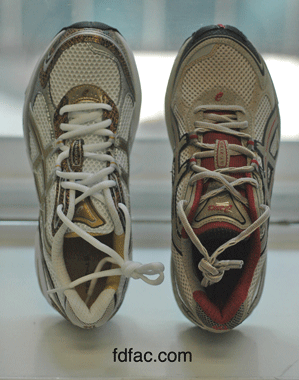
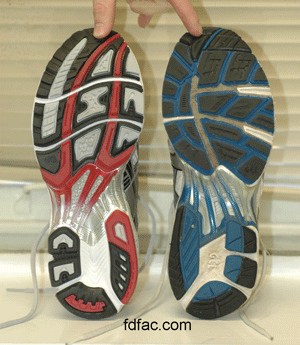
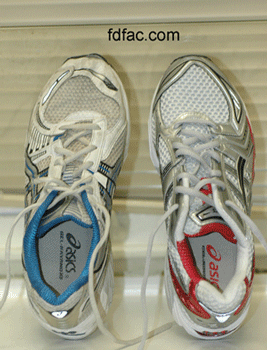
I ordered a pair of Asics 2130 running shoes from Zappos.com which turned out to be slightly short. Since I do more outdoor walking than running, I decided to order the Asics 2130 trail shoes instead, and was surprised to discover they are not the same shoe. The running 2130 is on the left, whereas the trail running 2130 is on the right.

The 2130 trail shoes are much wider than the Asics 2130 running shoes. The Asics 2130 trail shoes are much deeper than the running shoe version.

And the Asics 2130 running shoe is shorter than the same length 2130 trail running shoe.

Once again even though both shoes have the same name and outsole design, they are entirely different shoes. Make sure you thoroughly check the different version of the same shoe, because more and more, they will not be the same.

Shoe Review – Brooks Dyad for Wide Feet

I had a runner come it today with 3 different pair of running shoes.

The first pair were Brooks Adrenaline – which were much too narrow for her wide, deep foot. The next pair she tried were Saucony Pro Grid Omni which were better than the Adrenaline, but still too narrow in the waist (center arch) of the shoe. The shoes which fit the best are the Brooks Dyad, which as you can see, barely hourglass in.

Now look at the upper. Although both shoes are made by Brooks – they are different widths. The Dyad is wide, whereas the Adrenaline has a narrower upper.

When buying shoes, always check the outsole of your shoe, because just like Goldilocks, eventually, you’ll find an outsole which will be “just right”.

Nike Air Zoom Katana Cage II vs. Nike Air Refresh+

I was helping a runner find a new running shoe for her narrow shallow feet. Her old running shoes were Nike Air Zoom and fit her to a “T”.

The problem? Her perfectly fitting running shoes were discontinued and she was forced to buy the men’s version, which were similar, but much too wide for her narrow foot.

Armed with Zappos.com multi-view feature, I found two pair of potential replacement running shoes, both in a size 10.

nike.gif

Once again, even though both shoes were made by Nike and both shoes were sized 10, they were not the same length. The Katana Cage was easily 2 sizes shorter in the toe box and one size shorter in heel to ball measurement than the Air Refresh+. The Air Refresh+ on the other hand was proportional and fit perfectly, just like the original Air Zoom’s.

If you’ve got a very narrow, shallow foot, the Air Refresh+ is a great shoe for you. It’s also got the + technology, so grab your iPod Nano and go for a refreshing run!

Narrow Shallow Hiking Boots

Reader Becky writes:

I’m a female with a small, narrow foot. I have to wear boots at work, and many of the authorized boots I have found are too wide in the heel for me. I have no problems with day-to-day wear, but outdoors, I have to use a lot of moleskin on my heels to minimize blisters. Sometimes I get them anyway (once so bad I bled through my boots). Are there any inserts that I can buy to create a better fit in the heel? Do you know of any specific boots made with a narrow heel?

First of all – Thanks Becky, your question is great and lots of people who walk into my office have this very problem.

With respect to inserts, Superfeet (Green) may help, especially since they take up some of the excess space in the shoe. Also, wearing two pair of socks may help. However, if your heels still slip, then you’ll need to find a narrow, shallow boot.

Vasque hiking boots are made for both men and women and are one of the few brands of hiking boots which will give the narrow foot a snug fit. The top boot is the Switchback style and the bottom shoe is the Blur style.

vasque.gif

Another outdoor boot I’ve found that works for this foot type is the Ecco Urban Flexor GTX. Although less hard core than a backpacking hiking boot, this lighter weight hi-top will also fit the narrow, shallow foot.

eccoboot.gif

Both Vasque and Ecco brands are available at Zappos.com

Shoe Review – Asics 2130

It’s usually difficult to find a snug fitting running shoe if you have a narrow foot. Even harder if you have a narrow, shallow foot. Nearly impossible if you have a narrow, shallow foot with a bunion.

I was pleased when a patient brought this shoe in today, especially because it fits the narrow, shallow foot perfectly. The Asics 2130 comes in a 2A (narrow), B (medium) and D (width), and all work for a shallow (flat) foot type.

asics_2130.gif

The Asics Gel Kayano also works for a narrow foot, but the 2130 actually is slightly more shallow and narrow and significantly lower in price.

Don’t miss my other 2130 posts:  https://drshoe.wordpress.com/2008/08/10/womens-asics-2130-updated-styles/

https://drshoe.wordpress.com/2008/06/24/shoe-review-asics-2130-new-vs-old-differences/

https://drshoe.wordpress.com/2008/04/13/shoe-review-asics-2130-running-vs-trail-shoes/

Shoe Review – Asics GEL-Kayano

A marathon runner came in today with a worn pair of GEL-Kayano 12 and a new pair of GEL-Kayano 14. Even though both shoes were sized the same length and width, they were entirely different shoes.

gel_kayano.gif

First, look at the outsole. The newer version is on the left and the older version is on the right. There is more soft EVA in the worn outsole on the right, which would cause the forefoot padding of the shoe to break down sooner.

If you have a history of ball of the foot pain (capsulitis, sesamoiditis, metatarsalgia), you will want your outsole EVA to be as firm as possible, so the left model would be better for you.

gel_kayano_3.gif

Next look at the upper. See how the older Asics on the left is wider in the toebox and in the heel opening or throatline? In this case, if you have a wider foot or a higher arch, the older version would be a better fit for you.

All in all, even though the name is the same, the versions are not. Bottom line – these differing versions are entirely different shoes. Although both are shallow in toebox depth, version 12 will work best if you have a wide, shallow foot whereas version 14 will work better if you have a narrow, shallow foot.

Beware of version upgrades and check them carefully. Even if you shoe salesman swears up and down there is no difference, don’t take their word for it, make sure with your own eyes and hands it is indeed the same shoe.

Shoe Review – Privo Ronan

In general, I like many of Clark’s Privo Styles. I especially like this Ronan style because:

  • Shallow toe box – If you’re heels slip up and down in casual or flats type shoes, then you foot probably flattens out when you walk. In this case, the volume of your foot is less than the interior volume of your shoe. The Ronan toe box scoops down and is shallow over the toes, matching more closely the volume of your forefoot.

privo_ronan_1.gif

  • Removable insole – The insole of this shoe is thick and removable. That means if your need to wear custom orthotics, you’ll have enough room for your orthotics, once you take out the shoes insoles.
  • Adjustable vamp – This is also helpful if your heels typically slip. The elastic is adjustable and in exactly the right spot for the upper to form fit.

privo_ronan_2.gif

This shoe will work if you have a wide, shallow (low volume) foot, with ball of the foot pain, hallux limitus pain or neuroma pain.

This shoe won’t work if you have a bunion. Unfortunately, there is stitching right over the bump, making the shoe much too tight where you need it the most.

Stay tuned though – I will be blogging about another Privo style that is perfect for a bunion foot.