Category Archives: Sport Specific Shoes

Shoe Review – Asics Gel Evolution 4 (Men’s)

Trying to find a shoe for a wide foot can be a problem, especially if your foot is deep and wide. Many podiatrists tend to go with Brooks (Addiction) or New Balance (1123) which isn’t always the best choice. In fact, Asics Gel Evolution in many cases is a much better choice, especially if you wear size 2E.

evolution_4_1

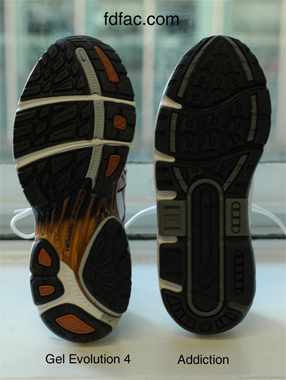
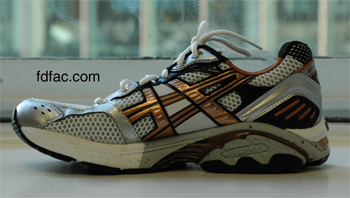
As this image below shows, the Gel Evolution in Wide (2E) is much wider than the Brooks Addiction in 2E. It is also has a firm heel counter making it much more stable than the New Balance and much better overall for pronation control in addition to being lighter weight.

evolution_addiction evolution_4_medial2

Bottom line, if you have a wide foot and are wishing for sleeker design, lighter weight, stability and motion control in your running shoe, then Asics Gel Evolution 4 may be just right for you.

Tango, Salsa and Ballroom Shoes – Jorje Nel Dance Design

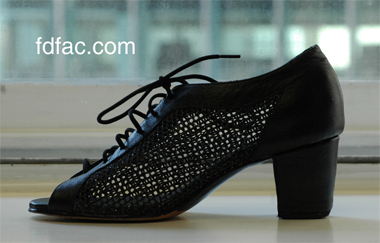
I don’t usually get a lot of Tango dancers, but today RL came in with these beautiful Jorje Nel Design Dance Shoes https://tangoinmiami.com/. The style is Fernanda Ghi. She found them online and sent in a weight bearing foot tracing along with her order to ensure proper fit. I think these shoes are fabulous for the following reasons:

  • Lacing from ankle to toe allows for depth adjustment, which is especially great if you have a wide foot.

tango_side

  • Mesh upper accommodates bunions and hammertoes allowing for a more variable fit.
  • Waist width is wide which will provide  more overall support of the foot while dancing.

tango_top

What I don’t like, is that even though a weight bearing tracing was sent in, the overall length was easily 2 sizes too short because RL has a longer heel-to-ball measurement than heel-to-toe.  For why this is important, see my related post https://drshoe.wordpress.com/2007/12/05/size-matters-heel-to-ball-vs-heel-to-toe/

If you are a tango dancer and you purchase shoes from Jorje Nel Design, you will want to know whether your heel-to ball or heel-to-toe measurement is longer and not only have them use your foot tracing but your proper length (heel to-ball or heel-to-toe, whichever is longer) measurement as well.

All in all though, if the length is correct then I am a big fan of this particular shoe.

Shoe Review – Adidas adiPURE TRX FG

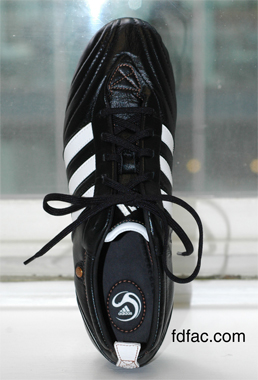
AR came in today with her new soccer cleats – Adidas adiPure. AR has a wide foot, so she wears men’s soccer cleats, which is a great idea for women who have trouble finding wide enough women’s cleats.

In addition to being wide, the adiPure is made with extremely soft leather which helps with fit. The shoe also has a removable sock liner which can accommodate an orthotic if you need it. Even though the width looks narrow based on the outsole, inside there is a wide insole which provides a great foundation for your foot, especially if it’s wide.

This shoe can be found on Zappos.com in both men’s and women’s sizes. http://www.zappos.com/n/p/p/7419865/c/148832.html

Shoe Review – Brooks Addiction 7 vs. 8

The Brooks Addiction is similar to the Beast in that it is wide, deep and very stable which is good for heavy pronators. Recently the Addiction 8 was released and it is a significantly different shoe than the Addiction 7.

Toebox Length and Depth – Substantially longer toebox in the Addiction 8 vs. the 7. This may be good or bad depending on whether your heel to ball or heel to toe measurement is longer https://drshoe.wordpress.com/2007/12/05/size-matters-heel-to-ball-vs-heel-to-toe/ The toebox depth in the Addiction 7 is much deeper than in the 8, or put differently, the 7 has more overall volume than the 8.

Width and Outsole Shape – The Addiction 8 is much narrower and has a much straighter last than the Addiction 7. If you have been successfully wearing the 7 you may need to go wider in the 8.

Overall, I’m pleased with the changes and much prefer version 8. It is more streamlined and proportional to the average foot than then 7. If however you have short toes, then you may want to try the Brooks Dyad, which has a shorter toebox than the newer Addiction 8.

For my review of Addiction 9 see the following post https://drshoe.wordpress.com/2010/08/03/shoe-review-brooks-addiction-8-vs-9/

Cycling Shoes – Bunions

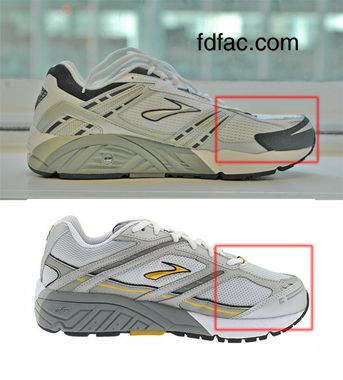
If you have a bunion, finding a cycling shoe that’s wide enough can be a challenge, especially if the rest of your foot isn’t wide. One solution is to find a shoe with mesh over the bunion which will be more forgiving than leather or vinyl trim. The image below shows an older model Pearl Izumi shoe which had trim over the bunion, making the shoe too tight.

In this case, the simple solution was cutting away the trim in the area of the bunion, to expose the mesh. This allows for expansion of the forefoot without compromising the rest of the shoe fit.

Skating Boots – Modifications

This is the same roller derby boot as my earlier post. https://drshoe.wordpress.com/2008/08/05/skating-pain-bay-area-roller-derby-girls/

These principles would work for any sport boot including hockey, figure skating and roller blading.

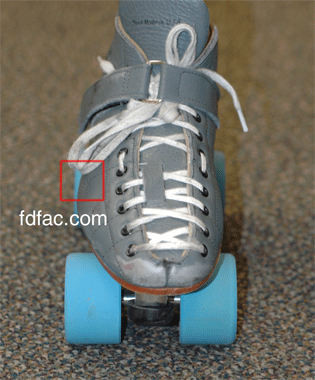
Although the modified lacing I previously blogged about helped, it wasn’t enough to alleviate all the outside of the foot pain, so I added permanent padding on the inside of the boot to off-weight the painful prominences and it worked like a charm.

Just because a boot isn’t custom, it doesn’t mean you can’t customize the fit. All you need is a creative shoe repair person and you should be fine.

Skating Pain – Bay Area Roller Derby Girls

Today, one of the Bay Area Roller Derby Girls (B.A.D.) http://www.bayareaderbygirls.com/ came in having outside of the foot pain and swelling, primarily in her new boots. The pain was partially due to the motion of skating (push off) and partially due to boot forefoot compression and tightness because the outside of her foot was enlarged in this area.

A simple fix is to modify the laces. Whenever a shoe laces, you can always skip the eyelets to increase forefoot width as above. Here are some other posts where I blog about lacing modifications.

https://drshoe.wordpress.com/2008/02/03/top-of-the-foot-bump/

https://drshoe.wordpress.com/2008/01/07/shoe-lacing-narrow-feet-hiking-boots/

https://drshoe.wordpress.com/2008/05/02/heel-slippage-improper-shoe-lacing/

Modifications Part 2 can be found at:

https://drshoe.wordpress.com/2008/08/11/skating-boots-modifications-part-2/

Spin Class – Arch Pain

Reader Pete asks “I have been in a spin class for 8 months. Recently I have developed chronic right arch foot pain to the point that it’s difficult to walk for several days after class. I have severe flat feet that pronate inward-no arch at all. I am cycling with cage on pedal. Would cleats be better for the foot pain? The problem is worse when standing or climbing.”

Sounds like you’re getting plantar fasciitis (arch or heel pain). Your flat feet are most likely the cause. As long As long as you have stiff soled cycling shoes, it shouldn’t matter whether you use cages or cleats. As for the pronation, you might want to try a non-custom orthotic and see if this helps. Superfeet are good, and they make a cycling specific insoles (new yellow below). 

Have you been to a podiatrist? If not, you should see one. He or she should be able to get you back on track (stretches, physical therapy, taping, custom orthotics) in no time.

Shoe Cleats – Beware of Wear

If you play a sport which requires wearing cleats (soccer, baseball, football, golf) then you want check your cleat wear regularly.

Here’s a pair of turf soccer cleats, which are about a year old. As this image shows, the heel cleat on the right shoe is still flat, causing a pivot point and a protrusion force upward as compared to the heel cleat on the left shoe, which is evenly worn with the other cleats.

In this case, the cleat on the right shoe actually caused plantar fasciitis – heel pain, which could have been avoided if the shoes had been replaced before the cleats started to wear asymmetrically.

Shoe Review – La Sportiva Trango Trek GTX

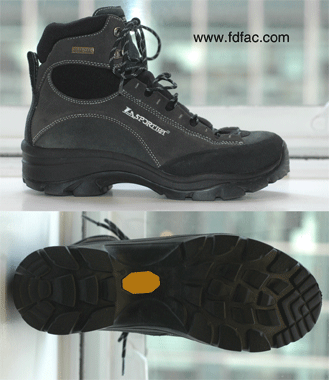
Thanks to Bill for bringing in this pair of hiking boot today. This is a great boot if you have a narrow, deep foot. Vasque is for a narrow shallow foot, whereas LaSportiva is for those feet having slightly more volume with a narrow width.

This is a sturdy hiking boot good for variable terrain including lots of hills. It also cinches up tight for narrower ankles.This boot can be found at REI and several other retailers for around $180.

Shoe Review – Brooks Dyad for Wide Feet

I had a runner come it today with 3 different pair of running shoes.

The first pair were Brooks Adrenaline – which were much too narrow for her wide, deep foot. The next pair she tried were Saucony Pro Grid Omni which were better than the Adrenaline, but still too narrow in the waist (center arch) of the shoe. The shoes which fit the best are the Brooks Dyad, which as you can see, barely hourglass in.

Now look at the upper. Although both shoes are made by Brooks – they are different widths. The Dyad is wide, whereas the Adrenaline has a narrower upper.

When buying shoes, always check the outsole of your shoe, because just like Goldilocks, eventually, you’ll find an outsole which will be “just right”.

New Balance 645 vs. Brooks Infiniti

I’m always on the lookout for men’s narrow running shoes. Searching through Zappos.com I found the New Balance 645 running shoes and the Brooks Infiniti running shoes for a patient of mine. Both have narrow outsoles with the New Balance being slightly narrower overall than the the Brooks.

nbmr645_brooksinfinity.gif

Next comes the upper. The New Balance toebox is deep, whereas the Brooks toebox is shallow which was exactly what I was looking for.

nb_brooks.gif

I also like the Brooks Infiniti because it has a firm medial (grey) outsole. The Brooks Adrenaline (not shown) is similar in upper design, but will be much less long lasting because of its softer the outsole.

The only downside with the Infiniti? The price tag. $124 on Zappos. com. I usually prefer a more affordable running shoes (Asics 2130), but if this is your foot, then it’s probably worth it to you. Especially given how difficult shopping for a well fitting running shoe can be.

Nike Air Zoom Katana Cage II vs. Nike Air Refresh+

I was helping a runner find a new running shoe for her narrow shallow feet. Her old running shoes were Nike Air Zoom and fit her to a “T”.

The problem? Her perfectly fitting running shoes were discontinued and she was forced to buy the men’s version, which were similar, but much too wide for her narrow foot.

Armed with Zappos.com multi-view feature, I found two pair of potential replacement running shoes, both in a size 10.

nike.gif

Once again, even though both shoes were made by Nike and both shoes were sized 10, they were not the same length. The Katana Cage was easily 2 sizes shorter in the toe box and one size shorter in heel to ball measurement than the Air Refresh+. The Air Refresh+ on the other hand was proportional and fit perfectly, just like the original Air Zoom’s.

If you’ve got a very narrow, shallow foot, the Air Refresh+ is a great shoe for you. It’s also got the + technology, so grab your iPod Nano and go for a refreshing run!

Wider Puma Alternative

Reader Dave asks “Would you happen to know of any type of shoe for a street dancer? Right now I wear Pumas because they’re light and there are great styles but these Pumas are a bit tight on me.”

Dave’s right, Puma’s are lightweight but they are very narrow and shallow.

These images show two similarly designed shoes. Saucony are the deepest and widest, but the Asics are still better than the very shallow, narrow Puma, both in depth and outsole width. Just like the Puma, Saucony and Asics are also affordable.

street_performer.gif

Fortunately, most designers make similar styles, so if you’ve got your heart set on a certain style don’t despair, just try another manufacturer.

Orthotics Too Wide For Heels of Shoes

Here’s an example of an orthotic that doesn’t fit properly in the shoe. An orthotic shouldn’t push the sides of your shoes and heels apart as seen in this right shoe.

orthotics_wide_heels.gif

What an orthotic should do, is easily fit into the back and arch of your shoe. Notice how the heel of the shoe with the orthotic in it is round in shape, whereas the shoe without the orthotic, is much tighter in the back of the heel?

Custom orthotics should not cause your heels to slip or push out the sides of your shoes. Since different types of orthotics can be made for all of your different types of shoes (heels vs. flats vs. running shoes), you should ask your podiatrist about getting multiple pairs of orthotics if you wear lots of different shoes.

Good Dog, Bad Dog Walking Shoes

If you are engaging in any activity which requires prolonged walking, hiking, standing or jumping, you should be wearing

  1. A shoe that fits
  2. A shoe that provides support.

The owner of these Merrell clogs needed shoes she could get on easily, because her jumping Labradoodle, anxiously greeted her whenever she started getting ready for their walk.

merrill_labradoodle.gif

The only problem is, the easier the shoe goes on, the harder your feet have to work to keep them on, especially if they’re too big. The end result is a happy dog and unhappy feet.

In this case – plantar fasciitis. Notice how the heel counters (back of shoe) are collapsing? This collapse is called pronation and pronation can cause plantar fasciitis. If your foot has pain, the shoes more than ever have to fit right.

Running Shoes – Forefoot Outsole Flex Grooves

A runner came in today with a moderately worn pair of Asics running shoes. Having solved her left heel pain with orthotics some time ago, she was now in my office because she started having increasingly painful ball of the foot pain during her runs.

A quick runway walk down my hall in her Asics shoes showed a stable rearfoot with no excessive pronation in site. Her orthotics were performing like a dream, so that couldn’t be it…what then? Had she changed her mileage or running surface?…No. Had she started to run at a different time of day?..No.

I thought to myself, there had to be a hidden clue – something telling about her shoes. And for me, this is where the fun comes in. I had her shoes off in a flash and got to work. Bending, flexing and twisting her shoes. Vertical heel counter – check. Proper volume – check. Mesh over her bunion – check. and then I saw it, like a lazy snake in the grass. What about the shoes outsole flex point? Could that be the problem? Yes, yes, yes!
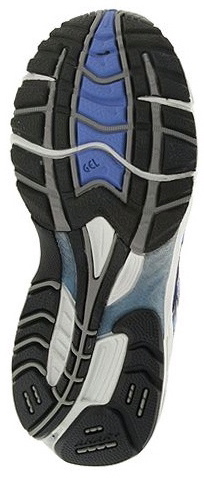
Sure enough, when I had her put the shoes back on, I realized that the ball of her foot lay directly over the flex point. Furthermore, this area had no overlying rubber on the outsole and was simply soft EVA, which is pumped full of air for lightness but not necessarily shock absorption. Aha, that was it, the shoe was bending up at at the forefoot flex point, which hammered the ball of her foot against the ground.

This was confirmed by the fact that I had her bring her prior running shoes in which had two flex points instead of one. And neither flex point on the old shoe was centered across the ball of her foot. Another shoe success story, another injury averted and another happy patient.

Take home message – New onset foot pain is not normal. First check the feet and if they’re fine, then check the shoes. Every little thing counts, and you have to be your own best advocate and intimately get to know your shoes.

Cycling Shoes – Cleat Placement

An interesting week, two separate cyclists, two separate injuries, both caused by cleat placement. As an aside, this is a shameless plug for my friend, Jerry Durham who also happens to be an extraordinary Sports Medicine Physical Therapist and maniac Century cyclist. If you’re a cyclist with injuries, need rehab or want a custom bike fitting from someone who knows and understands the biomechanics of cycling better than anyone I’ve ever met, then Jerry is you guy.

Cyclist #1: Numb toes only when cycling distances beyond 14 miles. Return of sensation usually complete by next morning. Hills, speed or terrain don’t affect onset, but distance does. Evaluation of his cycling shoes, showed that they fit perfectly.

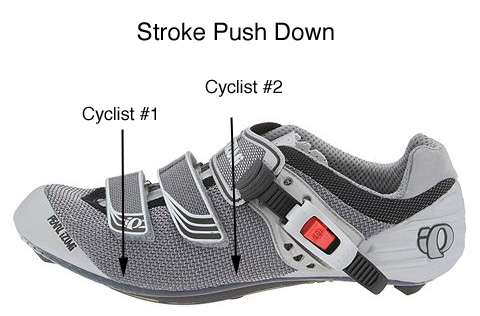
Evaluation of his cleats, showed that they were not positioned squarely under the ball of his foot but had been moved forward by the bike shop. With a forward positioned cleat, the push down part of his stroke shifted his body weight in the shoe and because the forefoot of the cycling shoe angled up, when his body weight pushed down, it caused his forefoot to flatten due to the forward cleat placement. This in turn caused nerve compression, leading to numbness. Once we moved his cleat back the numbness stopped.

stroke_push_down.jpg

cleat_placement.jpg

Cyclist #2: This patient presented with a stress fracture right, 2nd metatarsal shaft (midfoot). Patient started riding to work 20 miles both ways, 10 miles downhill in the morning, 10 miles uphill after work at 5pm. Patient pushed himself harder and harder during the end of day ride and pleased with his efforts (and screaming endorphins), he decided to train for a Century ride. Committing to a new personal best each day, it was no wonder his foot was the only injured body part. Evaluation of his cycling shoes showed the exact opposite cleat placement from the cyclist above.

Take home message – Check your seat height and check your cleat placement. Oftentimes, cycling ball of the foot numbness can be alleviated with Superfeet, but if not – check where your pedal clips in.

Peace out.