Women’s Asics 2130 – Updated Colors

Women’s Asics 2130 is one of my favorite shoes. It works for narrow and wide feet, which are shallow in depth. It’s not quite as narrow as the now discontinued 2120 but it does come in a 2A width which is great.

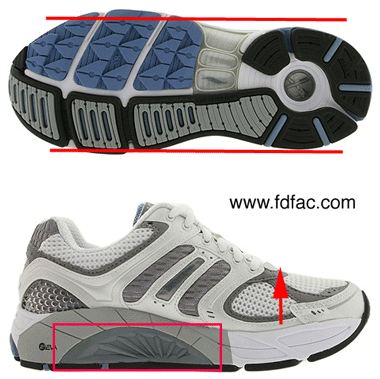
Recently (7/08), Asics released new colors of the 2130 which is good or bad depending on what you’re looking for. The new version is slightly narrower and a 1/2 size shorter, than the older models. The new colors can be found on Zappos.com, in Black/Platinum/Cherry and Storm/Lightening/Hot Pink, which is the shoe below.

If you’re wearing the old version and purchase one of the newer colors of this shoe, carefully compare it to your existing fit. You may need to go up in size or width to get the same fit.

Anatomy Of A Shoe – What You Don’t Know Can Hurt You

Important to the understanding of footwear and footwear function is the understanding of construction, or in this case – footwear anatomy. What follows is basic shoe anatomy. Instead of listing all parts of the shoe (welting, foxing etc), I have instead tried to convey a general overview, especially as it relates to the foot and more specifically, foot pain.

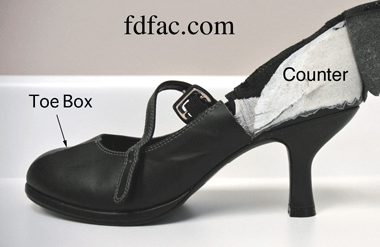
The anatomy of a shoe can easily be divided into two parts; the top 1/2 of the shoe is the Upper and the bottom 1/2 of the shoe is the Lower. These images show the main parts of the upper.

  • Toe Box – Area overlying the toes. Think of this area in terms of depth. The deeper the toe box, the more room your toes have. This is important if you have hammertoes or other top of the toe irritation or pain.
  • Vamp – This part of the shoe covers your arch. This section is a bridge between the toe box and the opening of the shoe or topline. You want the vamp of your shoe to fit snug. Too loose and heel slippage occurs, too tight and numbness in the toes can occur.
  • Counter – The back part of the upper which wraps around either side of the heel. The counter can be soft (collapsible) or stiff (non-collapsible). Stiff counters are usually better if your foot pronates a lot or your foot collapses immediately after heel strike.

The lower is what your foot rests on and includes the insole, shank, midsole, outsole and heel.

  • Insole – The insole is the foundation of the shoe. The upper is wrapped around the insole, the metal shank is riveted on the underside of the insole and outsoles, midsoles and heels are added as well.
  • In running shoes, this is oftentimes referred to as the lasting method. Cardboard lasted uses a cardboard insole, whereas slip-lasted uses cloth. A combination last combines both cardboard and cloth.
  • The softer the insole, the less torsional stability (lengthwise twist) the shoe will have. The firmer the insole (cardboard) the more structure and stability the shoe will have. Pronators or people whose feet collapse excessively, typically want a cardboard last.
  • Midsole and Outsole – Used to give a shoe more cushion and shock absorption. Running shoes almost always have a thick midsole. I’ve talked about EVA midsoles in other posts, suffice it to say the firmer the midsole, the stiffer and longer lasting the shoe. Soft midsoles on the other hand help with shock absorption, but wear out more quickly. Here are some related posts on running shoe midsoles

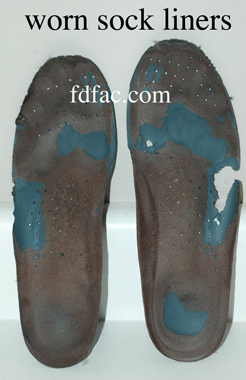
  • Sock Liner – Usually removable and rests on the insole. Many people confuse the sock liner with the insole. The sock liner serves a cushioning function, whereas the insole provides a structural one
If you are having foot pain, it will help to match your anatomy to your shoes anatomy or at least think about how a shoe is made, before you buy next time.

Shoe Review – Adidas Terrex Low Hiking Shoe

Narrow, shallow hiking boots are usually difficult to find. The Adidas Terrex Low Hiker is a perfect match to this foot type. It is torsionally stable (doesn’t twist) and has an inflexible forefoot sole which you want, especially when hiking on irregular terrain.

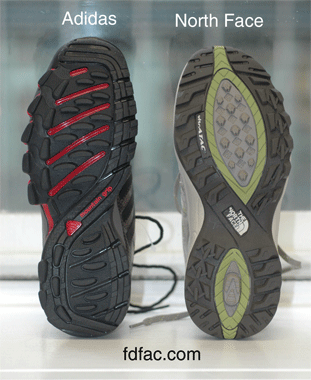
Here is what the Adidas Terrex looks like from the top and side views.

The following images compare the Adidas Terrex on the left with the wider North Face Furry, Gore-Tex, XCR on the right. Notice the difference between the outsole width. The Adidas is much narrower and shallower than the North Face.

The Adidas laces also extend closer to the toes, which provides more adjustability in the forefoot width than the North Face.

If you have a narrow foot and need a great lightweight low top hiker, then this shoe may just be for you.

Body Language Interview – Head to Toe

My public radio interview went live today on www.healthradio.net. You can hear the interview with show host Chris Springmann at www.bodylanguage.org – Show 5, Head To Toe, segment four, right after the vet interview. I would love to hear what you think!

Skating Pain – Bay Area Roller Derby Girls

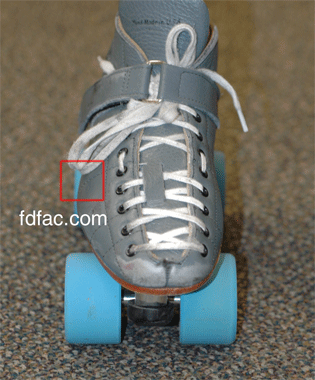
Today, one of the Bay Area Roller Derby Girls (B.A.D.) http://www.bayareaderbygirls.com/ came in having outside of the foot pain and swelling, primarily in her new boots. The pain was partially due to the motion of skating (push off) and partially due to boot forefoot compression and tightness because the outside of her foot was enlarged in this area.

A simple fix is to modify the laces. Whenever a shoe laces, you can always skip the eyelets to increase forefoot width as above. Here are some other posts where I blog about lacing modifications.

https://drshoe.wordpress.com/2008/02/03/top-of-the-foot-bump/

https://drshoe.wordpress.com/2008/01/07/shoe-lacing-narrow-feet-hiking-boots/

https://drshoe.wordpress.com/2008/05/02/heel-slippage-improper-shoe-lacing/

Modifications Part 2 can be found at:

https://drshoe.wordpress.com/2008/08/11/skating-boots-modifications-part-2/

Spin Class – Arch Pain

Reader Pete asks “I have been in a spin class for 8 months. Recently I have developed chronic right arch foot pain to the point that it’s difficult to walk for several days after class. I have severe flat feet that pronate inward-no arch at all. I am cycling with cage on pedal. Would cleats be better for the foot pain? The problem is worse when standing or climbing.”

Sounds like you’re getting plantar fasciitis (arch or heel pain). Your flat feet are most likely the cause. As long As long as you have stiff soled cycling shoes, it shouldn’t matter whether you use cages or cleats. As for the pronation, you might want to try a non-custom orthotic and see if this helps. Superfeet are good, and they make a cycling specific insoles (new yellow below). 

Have you been to a podiatrist? If not, you should see one. He or she should be able to get you back on track (stretches, physical therapy, taping, custom orthotics) in no time.

Heel Taps – Spend A Little Save A Lot

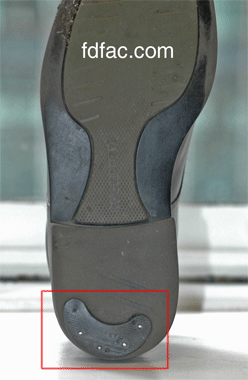
Here’s an example of a heel tap on a shoe.

Commonly made out of plastic or rubber, heel taps help prolong the life of your heeled shoes. Normal heel wear is on the outside so the taps should be placed here. Considering a pair of taps cost less than $10 and re-soling a pair of heels can run as much as $50, taps are a good value and easily applied. The plastic taps aren’t as durable as the rubber ones, so if your shoe repair person carries rubber taps, you’ll be better off.

Top of The Foot Bump – Part 2

Reader Kevin asks “I have a soft tissue swelling (with pain) on the top of my left foot, beneath my ankle and toward my pinky toe. Can’t find any information on it. Any suggestions would be appreciated.”

My suggestion would be a ganglion. A ganglion is usually an out pocketing of a joint including fluid (think balloon), which creates a soft mass in the skin which can enlarge and shrink, depending on the overlying irritation. It’s usually non-tender but can become painful, especially if it enlarges with fluid and there is pressure from a shoe rubbing against it.

This image shows a mild ganglion on the outside of the foot. Ganglions can also occur in the wrists, and legend has it that bibles were used to smack the area as hard as possible to disperse the fluid within the sack. I prefer to use a syringe.

If that doesn’t work, then surgical excision is sometimes necessary as this video shows:

If you have an unusual swelling under the skin on your feet, you will want to have it evaluated by a podiatrist in your area.

For another cause of top of the foot bump see my related post https://drshoe.wordpress.com/2008/02/03/top-of-the-foot-bump/


Callous Is Not Your Friend

At least once a day a runner comes in with callous and blood blisters which have formed because of the callous burrowing into the skin. Time and again, I’m told that the person has been instructed not to remove the callous as it is protective in nature. Not true. Although callous initially builds to cushion and protect, eventually it becomes an irritant causing more harm than good.

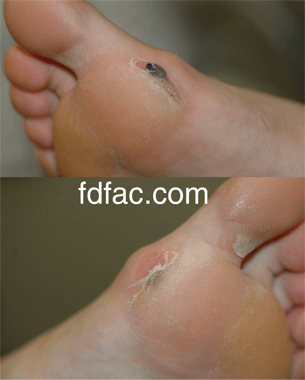
The above images are of runners whose callouses have become blood blisters. If you have callous, either file it off or seek treatment with a Podiatrist to do it for you. Your feet will thank you.

Bunions – Increased Forefoot Width

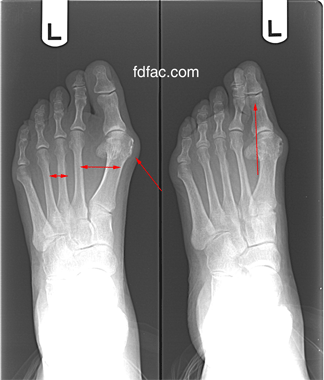
Here’s an image of a bunion which shows what the condition looks like on x-ray from two different views.

A bunion is a drift of the bones about the great toe joint. As you can see from the above images two things generally happen with a bunion:

  1. There is an increase in the angle between the the first and second metatarsals (long bones)
  2. There is a drift of the big toe toward the 2nd toe.

The net effect is an enlargement of the big toe joint on the inside of your foot and a widening of the forefoot in this area.

Bunions can make shoe fitting especially challenging. Things to consider are soft materials over the bump like mesh or weave materials. You will also want to avoid stitching or decorative trim over the bump. And finally, shoe stretchers can also help, see my post https://drshoe.wordpress.com/2007/11/29/its-a-stretch/

Shoe Of The Month – Ash® Patent Leather Ribbon Lace

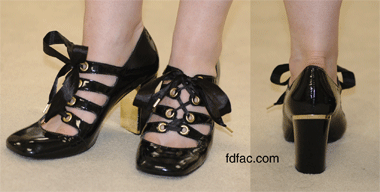
This is a beautiful and well designed shoe. Unfortunately, you won’t be able to find it anywhere online, as I just checked. It does however have some great features which are worthwhile to search for when buying a pair of high heels.

  1. The ribbon tie is adjustable accommodating different foot depths.
  2. The toe box is wide and rectangular which won’t pinch the toes.
  3. The heel comes straight down from the back of the shoe vs. offset, i.e. kitten style.
  4. The heel is 3″ which will work for most women.

The reason I don’t do many reviews on women’s shoes is because, whenever someone brings in a blog worthy pair, by the time they get to me the style has been discontinued. I therefore try and show you the design of shoes and what to look for.

Shoe Review – Saucony Progrid Omni 6 Ultimate

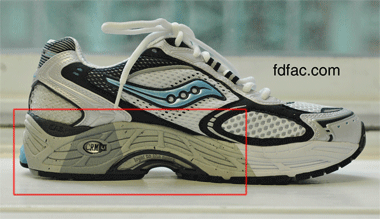
This shoe has a lot of mesh in the forefoot upper, which can help if you have hammertoes and /or bunions. The back of this shoe has a firm heel counter, which helps guide heel strike if you pronate excessively. This shoe also has firm EVA (ethyl vinyl acetate) in the midsole extending from the arch to the back of the shoe which makes it very stable.

A general rule of thumb is the darker (more grey) the outsole, the more firm or less flexible the shoe will be. This design feature helps those feet who need lots of support, especially at the rearfoot. The difference between the Ultimate and the Moderate version is the Ultimate has EVA which wraps around to the heel wheras the Moderate just has EVA in the instep.

The mens and womens version of this shoe come in medium and wide but not extra-wide and the toe-box is not too deep which can help fit considerably if your foot is wide and shallow.

Version 7 has just been released and from what I can see on Zappos.com, it looks to be essentially the same as version 6, but I’ll keep you posted if that changes. The other good news is, because version 6 is being upgraded, you can probably find this shoe on sale. At Sports Basement in San Francisco, this shoe is marked down from $100 to $64. Quite a deal for a well made shoe!

Shoe Review – Nike Air Pegasus Trail Shoe

D.M. came in today with his barely worn Nike Air Pegasus Trail shoes. He was recovering from a fractured sesamoid bone (small bone under the big toe joint) and wanted me to evaluate his shoes before he resumed running.

He had purchased the running shoes prior to his injury and spent over two hours in a specialty running shoe store, trying on every shoe in the store, because of his difficult to fit narrow foot. Finally, with the help of the sales staff, he found this Nike Air Pegasus Trail shoe. It was apparently rated highly by a runners magazine, which helped to close the sale.

The above image shows the shoe which on first glance appears moderately deep and wide, but I was keeping my fingers crossed, at least until I saw D.M. stand in the shoes.

Normally, the back area of the shoe (heel counter) should be perpendicular to the standing surface. As this image shows, the heels are turned out, which is not good for healing sesamoids, knees or alignment in general. No wonder he wasn’t getting better.

Moral of the story. Just because someone says shoe xy or z is the best shoe ever, make sure the shoe works for your foot and not someone elses. It could me the difference between healing and continued pain.

Shoe Review – Adidas 7406 Soccer Cleats

Finding a wide shoe for soccer is no simple task. Most soccer shoes fit painfully snug, so if your foot is outside of the bell shaped curve, trouble may loom ahead. I found this shoe for someone having serious ingrown nails, because of the narrow toebox fit. Luckily I found the Adidas 7406 which have a couple of great features and fit him perfectly.

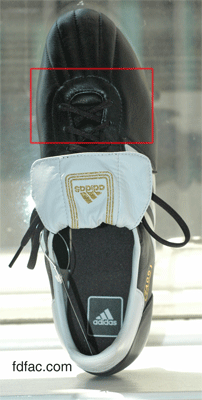
  • The eyelets extend beyond the ball of the foot, closer to the toes. This allows for width adjustability. Many soccer cleats don’t lace down this far and if your foot is wide, this can really help.

  • The arch width doesn’t hourglass in like most soccer cleats, given the arch full support as seen below.

And the overall width is slightly wider than most other soccer shoes and has a removable sock line which will accommodate an orthotic if you need one.

Saucony Grid Stabil – Lock Lacing Design

Saucony Grid Stabil has incorporated lock lacing into their design. It requires longer laces and if you don’t know how to cinch up the excess laces using this method, you could just trip and fall. 

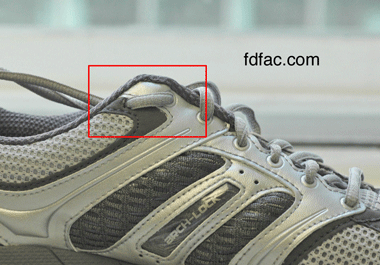
When you look at the eyelets from the side, lace through all of them just like this image shows.

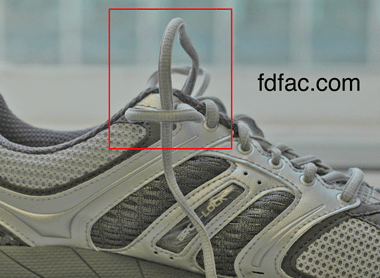
Now, instead of making the bow on the inside, take the end of each lace and thread through the loop on the opposite side. 

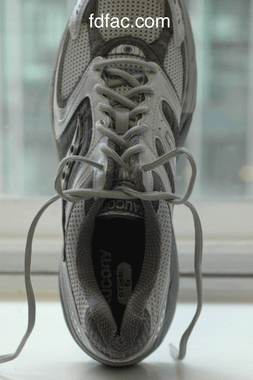
Finally, cinch tight pulling the laces horizontally from side to side. This method of lacing will stay tight until otherwise loosened. The only down side… it takes more time to tie and untie and if you don’t have a problem with heel slippage, then you have excess lace length for no reason at all.

Shoe Review – Saucony Grid Stabil

Saucony Grid Stabil is one of my favorite shoes and I recommend it at least once a day for the narrow (rectangular) foot. Surprisingly it works for shallow (flat) and deep (high arched) feet, because it comes in both medium and wide widths. For a refresher on foot width determination, refer to my blog posting https://drshoe.wordpress.com/2008/01/14/narrow-vs-wide-feet/.

As for the construction, this is one of the few running shoes which is proportional, meaning the heel to ball and heel to toe measurements are true to size (https://drshoe.wordpress.com/2007/12/05/size-matters-heel-to-ball-vs-heel-to-toe/). It’s also deep enough to accommodate a sport orthotic once you remove the sock liner.

It has a non-collapsible heel counter which helps guide heel strike and it has a firm inside mid-sole (grey above) which helps with pronation or foot collapse. Lastly the toe box is shallow meaning it will pass the pinch test (https://drshoe.wordpress.com/2008/01/15/pinch-test-shoe-toebox/), providing a secure fit, if your foot is lower volume than most.

Ten Tips To Foil A Flip-Flop Fiasco – American Podiatric Medical Association

Thanks to surgical resident Rachel for forwarding the American Podiatric Medical Association’s (APMA) “Ten Tips To Foil A Flip-Flop Fiasco”. My comments follow in italics.

Flip-Flop Do’s:

  • Do look for a flip-flop that is made of high-quality, soft leather. This material, unlike plastic or foam, will minimize the potential for blisters and other kinds of irritation. I don’t agree with this one, as there are lots of high quality flip flops that are not leather. Also, leather can stretch, causing the flip-flop to become loose over time.
  • Do look for flip-flops that hold APMA’s Seal of Acceptance, such as Chaco’ Flip Collection and Wolky’s Serenity, part of their Zen Collection. Evaluated by a committee of APMA podiatric physicians, these products are shown to allow for the most normal foot function and promote quality foot health. I think Chaco’s and Wolky’s are well made sandals, but they won’t work for every foot. Here’s my blog posting with my thoughts on running shoe lists. https://drshoe.wordpress.com/2007/12/14/running-shoe-lists-aarghhh/. I also think there are a lot more sandals than just Chaco’s or Wolky’s which allow for normal foot function.
  • Do gently bend the flip-flop from end to end, ensuring that it bends naturally at the ball of the foot. Shoes should never fold in half. Wise advice indeed.
  • Do wear a sturdy pair of flip-flops when walking around a public pool, at the beach, in hotel rooms in locker room areas. Walking barefoot can expose foot soles to plantar warts and athlete’s foot. If your flip flops are rubber, it’s a good idea to occasionally mist the wearing surface with Lysol Disinfectant Spray, to kill any harmful organisms which might hover on the top of the shoe.
  • Do ensure that your foot doesn’t hang off of the edge of the flip-flop.

Flip-Flop Dont’s:

  • Don’t re-wear flip-flops year after year. Thoroughly inspect older flip-flops for wear. If they show signs of severe wear in the soles, it’s time to discard them. Set them on a table to evaluate the heels. If flip-flop flops to one side, they need to be replaced.
  • Don’t ignore irritation between toes, where the to thong fits – this can lead to blisters and even worse irritation. Ditto for where the side straps insert into the flip-flops. If callous forms here or anywhere else on your foot because of the flip-flops, then it’s time to say goodbye to the flip-flops and get a new pair.
  • Don’t wear flip-flops while walking long distances. Even the sturdiest flip-flop offers little in terms of shock absorption and arch support. Gotta love common sense!
  • Don’t do yard work while wearing flip-flips. Always wear a shoe that fully protects the foot when doing outside activities like mowing the lawn or using a weed-eater. According to the Annuls of Emergency Medicine – Researchers analyzed emergency room and hospital records from 1996 to 2004 and found that nearly 663,400 people went to the emergency room and almost 12,000 people were hospitalized in lawn mower accidents during that period. Yikes
  • Don’t ever play sports in flip-flops. You can easily twist your foot or ankle, leading to sprains or breaks. More good advice.

Shoe Review – Pikolinos Romana 8809

Pikolinos is a Spanish company which has been around since 1984. Because they are imported, their price is higher than a lot of US brands, but Pikolinos are well made using quality materials which helps.

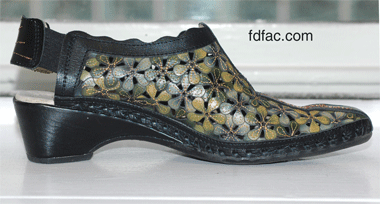
Someone came in today having a bunion, wearing the above shoe. Notice how the flowers on the upper are actually cut-outs? This is a great design and many Pikolinos have similar styling. This open weave eases tightness over protruding bunions or hammertoes, making it a very foot friendly fit. The only problem with this particular style is it won’t fit a really wide foot. 

Other styles can be found at Pikolinos website http://www.pikolinos.com/

Hammertoes

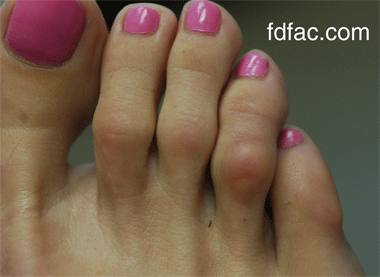
Many women who wear shoes that are too short develop hammertoes. This is a condition where the toes draw up, producing a buckling of the joints on the top of the toes.

Hammertoes typically occur more often in women having high arched feet as opposed to flat feet. Before you rush off to the surgeon though, have your feet measured and make sure your high heels are of proper length. Your toes will thank you.

Shoe Review – Asics Gel Cumulus 10 vs. 9

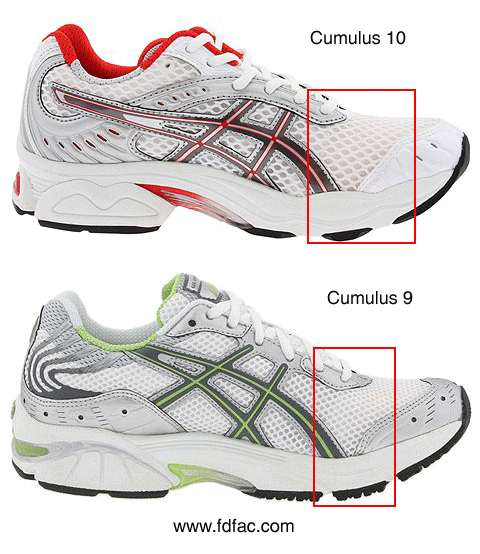
I wasn’t a fan of the Gel Cumulus 9 because of it’s flexibility and disproportional fit. I am a fan of the Gel Cumulus 10, especially if your foot is wide and you have a bunion. The Cumulus 10 has expanded the mesh in the area of the bump, which allows for less pressure in this area.

The cumulus 10 also has less flexibility in the forefoot than the 9 which can help alleviate ball of the foot pain.

The only downside of the Cumulus is the outsole, which is made of soft EVA which will tend to wear more quickly than a shoe with firm EVA. Both will accommodate a sport orthotic easily.